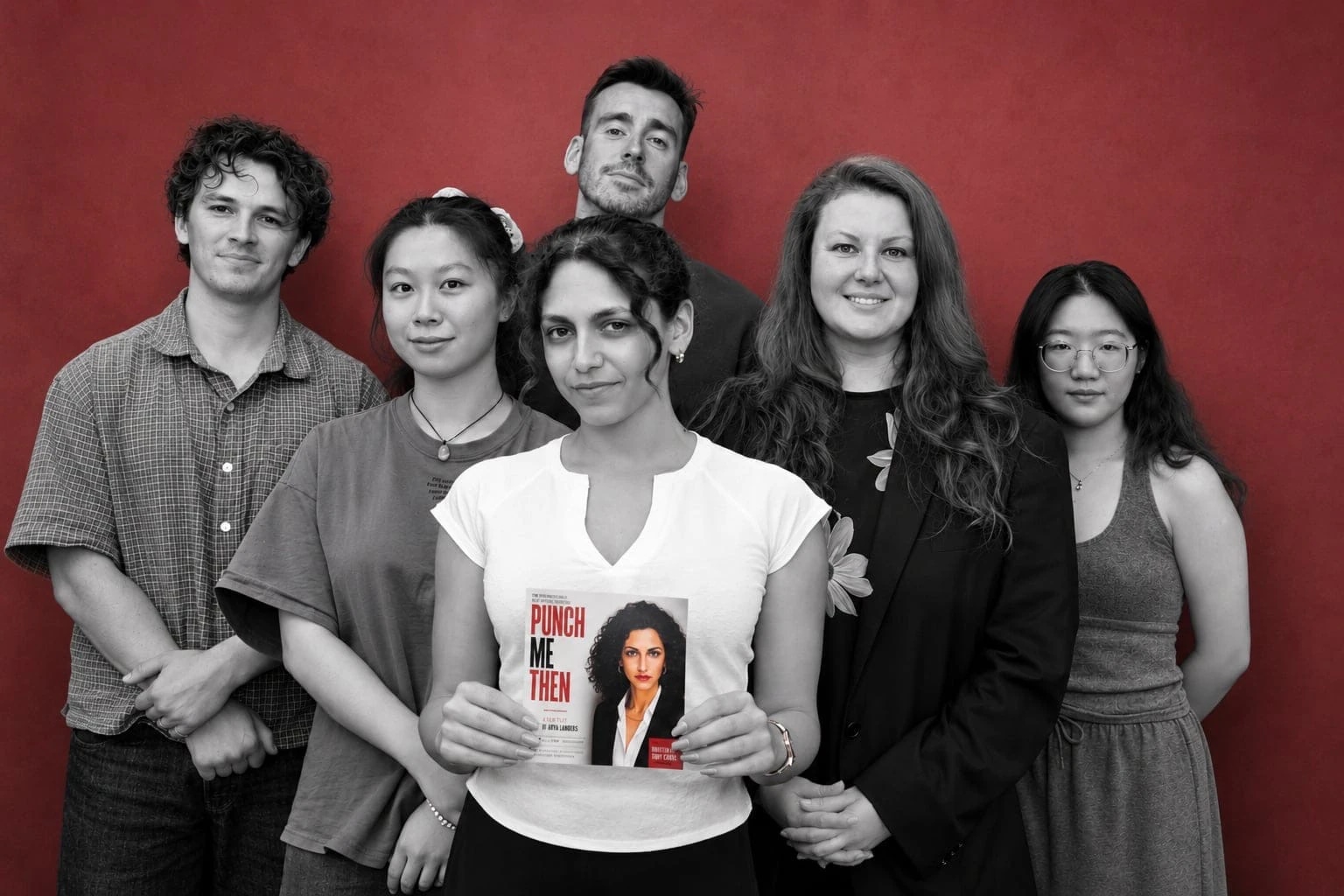
Image by Chamara SKG
Review by: Isabelle Wang
Rating: ★★★★★
When I entered the theatre at City Lit, seven or eight school desks had been arranged neatly across the stage, with every seat occupied. My immediate assumption was that this must be a large-scale production with a sizeable cast.
The arrangement of the desks, the space between the seats and the demeanour of the people onstage all clearly established the setting as a classroom. As the protagonist, Lila, began to speak, we followed this English literature teacher into the familiar world of a secondary school. She is young, energetic and genuinely passionate about teaching. Rather than simply passing on the knowledge contained in textbooks, she wants to teach her pupils how to think, question and analyse.
Yet when the performer began embodying a boy who habitually challenges his teacher, followed by a girl who insists on expressing her opinions in her own way, I gradually realised that this was not an ensemble production at all, but a solo performance. The apparently obedient “pupils” sitting behind the desks were, in fact, members of the audience.

This initial misapprehension provides Punch Me Then with its most effective point of entry. Who is a performer, who is a pupil, and who is merely an observer? Once members of the audience have taken their places in Lila’s classroom and begun responding to her questions and instructions, watching can no longer remain a wholly detached activity.
Lila opens her lesson with George Orwell’s Nineteen Eighty-Four and Animal Farm, seeking to show her pupils that people’s thoughts, language and ideologies do not develop in isolation, but can be shaped and influenced without their noticing. Faced with misogynistic attitudes already emerging among her teenage pupils, she refuses to ignore them. Through literature and discussion, she hopes to help the class recognise what lies behind such language.

During the lesson, Lila draws members of the audience into the class, encouraging everyone to reactivate their powers of analysis and independent judgement. She then introduces J. B. Priestley’s An Inspector Calls, using the experiences of Eva Smith to prompt a discussion about the injustices suffered by women. The lesson gradually draws the spectators into Lila’s attempt to turn reading into active reflection.
Lila believes that change becomes possible once pupils are willing to think. Her efforts, however, do not bring about an immediate transformation in their attitudes. Instead, the language used in the classroom gradually touches upon trauma she has kept buried for years. Personal memories begin to intrude upon her professional life, affecting her ability to manage the class and eventually provoking a fierce verbal confrontation with her pupils.
When Lila loses control and cries, “Punch me then”, the title finally lands onstage at the moment of her greatest vulnerability. This is more than a simple challenge. It feels like the eruption of everything she has suppressed for so long, directed simultaneously at her pupils, her past and her own sense of powerlessness. The confrontation shakes not only the order of the classroom, but also Lila’s faith in the lesson, in the power of literature and, ultimately, in her own capacity to make a difference.
The incident forces Lila to question both her original purpose as a teacher and her competence in the classroom. The confident educator who began the lesson determined to influence her pupils positively is almost entirely overwhelmed by failure, and the certainty with which she entered the room begins to give way.
Her uncertainty is painful to witness, but it also makes the predicament facing teachers deeply understandable. As wider social problems increasingly enter the classroom, teachers are expected to correct them, explain them and absorb their consequences, while the extent of their actual influence remains severely limited. Lila is responsible for what happens in her classroom, yet she cannot single-handedly change the family environments, online cultures and social attitudes her pupils encounter once they leave it.

The play brings Lila to a point of genuine uncertainty. We do not know whether she will be able to change her pupils, how she will confront her own trauma, or what place teaching can still occupy in her life. The ending offers neither an easy victory nor a neat defeat. Instead, it asks whether the destructive cycle of injury, breakdown and withdrawal can be interrupted—and whether anyone can continue an effort whose results may never be visible.

Nicole Abraham’s performance is undoubtedly the production’s strongest centre. She not only moves between several identities by herself, but also crosses differences of age, gender and social position. Whether playing the young teacher Lila or the pupils who repeatedly test the boundaries of her authority, Abraham makes each character vivid and recognisable.

These transitions depend on far more than changes of voice. They are expressed through shifts in physical balance, rhythm, speech, eye line and each character’s position within the classroom. The audience can almost immediately recognise these figures and connect them with a teacher or classmate from their own school days. This familiarity prevents the conflict from feeling like a hypothetical case constructed merely to carry a social message. Instead, it resembles something that could be unfolding in a real classroom.
As the playwright, Abraham also gives Lila considerable complexity. She is committed, responsible and convinced that education can change people. At the same time, she is imperfect: she can be wounded, she can doubt herself, and under sufficient pressure she can lose the restraint expected of a teacher. The play neither presents her as an educator who is always right nor uses her loss of control as a reason to dismiss everything she has tried to do.
Lila’s strength as a character lies precisely in this imperfection. Her vulnerability is not romanticised and her mistakes are not concealed, but the production refuses to reduce her to a single moment of failure. At the end of the performance, the audience applauds Lila while also cheering Nicole Abraham for carrying the production alone. That applause belongs not only to the skill of the performance, but also to the complexity of a character whose struggle remains unresolved.
The full potential of both the writing and the performance is realised through director Toby Clarke’s use of the stage. A solo show can easily confine its audience to a position of passive listening, but Clarke places some spectators directly onstage, seating them in Lila’s classroom and inviting them to follow the course of her lesson.

This interaction has not been grafted onto the production simply to make it more lively. Reading aloud, answering questions, debating and following a teacher’s instructions are all ordinary parts of classroom life, allowing the audience’s involvement to grow naturally out of the setting. The spectators behind the desks are both real audience members and the “pupils” Lila must teach. Even without scripted dialogue, their posture, silence, hesitation and willingness to comply become part of the performance.
Those who remain in the conventional auditorium occupy a second level of spectatorship. We watch Nicole Abraham perform, but we also watch other audience members responding to Lila’s questions and being absorbed into the order of her classroom. The production consequently creates two overlapping classrooms: one that Lila attempts to control and another in which the rest of us observe how that control is established and how it gradually begins to collapse.
At the beginning, Lila possesses the institutional authority of a teacher. She assigns tasks, selects readers and directs the discussion. As the lesson unravels, however, the fragility of that authority becomes increasingly visible. The audience sees that even a teacher standing at the centre of the classroom may not possess the power to change those sitting before her.
This double structure extends the production’s questions beyond Lila’s personal experience. As the performer and the audience members onstage confront misogynistic language together, those sitting in the auditorium are compelled to ask where the problem actually begins. Can it genuinely be resolved in a classroom? Once pupils leave school and return to their online and social environments, how much influence can a teacher’s efforts retain? How much responsibility can education reasonably be expected to carry?
The writing, performance and direction of Punch Me Then form a closely integrated whole. The production does not pretend that a single literature lesson can readily transform its pupils, nor does it provide Lila with a triumphant ending in which every problem has been resolved. Instead, it draws educators, young people, participants and observers into the same uncomfortable classroom relationship, forcing everyone to confront both the necessity of change and the limits of what change can achieve.
The play ultimately leaves us not only with the question, “Where did everything go wrong?”, but with more difficult ones: if we cannot know whether our efforts will succeed, should we continue making them? When education cannot accomplish change by itself, how much can the rest of us do?
The play does not offer a reassuring answer. Its hope lies instead in the possibility that confronting the problem, however uncertain the outcome, is more honest than pretending that the classroom can resolve it alone. That is the most honest and precious glimmer of hope that Punch Me Then offers its audience.