Image by Alba Campayo
Review by: Isabelle Wang
Rating: ★★★
The stage for Los años maravillosos: Archive, Image and Collapse is extremely spare: a table and a chair. They might belong to an interview room, or they might be remnants of an old family memory. Even before the performance begins, this empty, restrained space suggests that the production will not attempt to reconstruct a life in its entirety. Instead, it approaches an irretrievable past through the surviving fragments of an archive and its images.

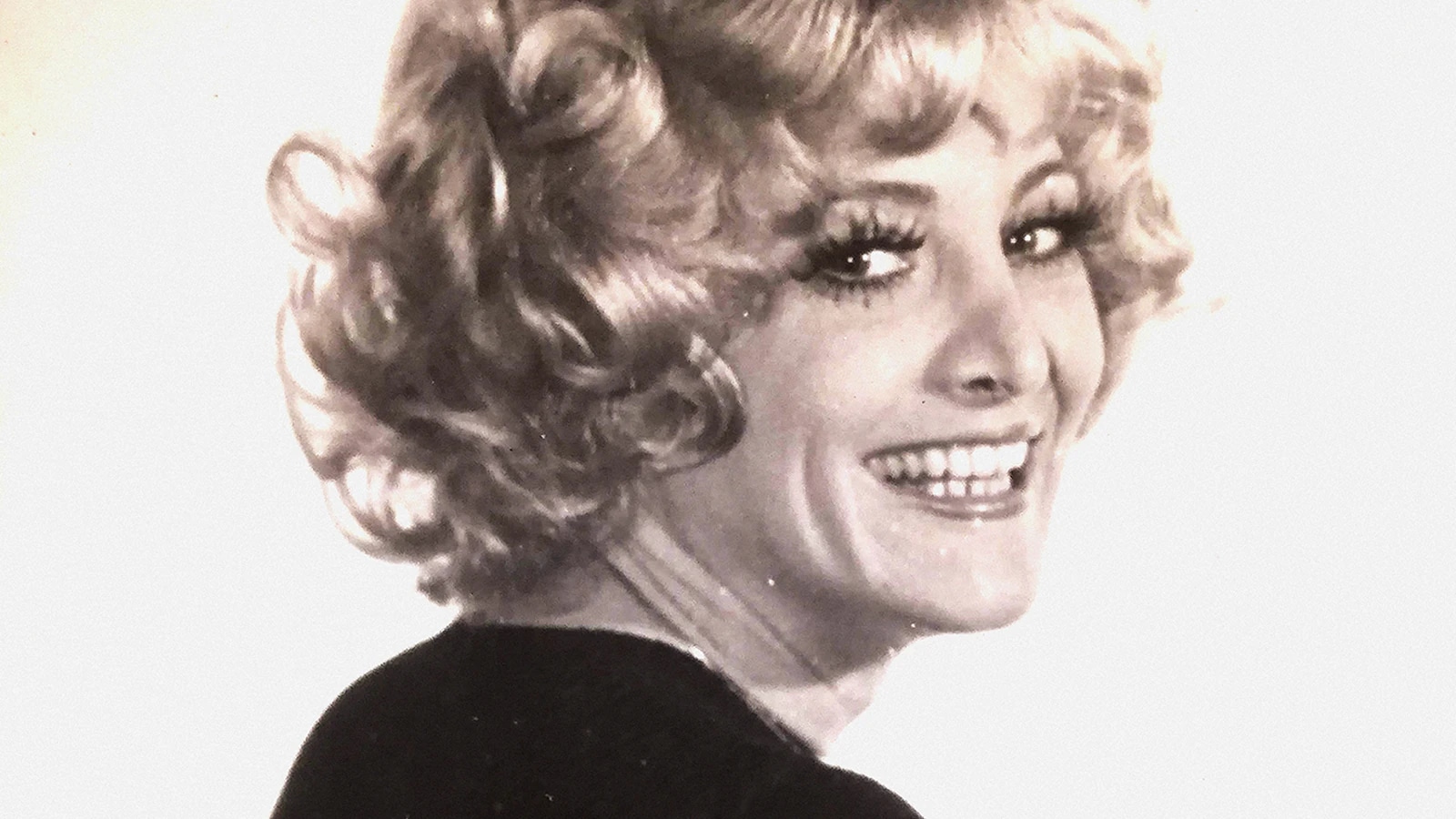
The performance begins with a projection of words attributed to Lilian Beares: ‘Optimism. Confidence. Faith in the Future.’ They come from a 1971 newspaper interview with Lilian, who was then a 25-year-old Uruguayan model. The projection offers the audience an initial impression of her, but it also resembles a carefully selected and polished headline, temporarily fixing a real person within a handful of bright, affirmative words.

A woman played by Alba Campayo then enters. Her hair is set in rollers; she wears a white T-shirt and pale blue jeans, and she is barefoot. There is something private and unguarded about the image, as though we are seeing a model before she is fully prepared to present herself to the world. She is also recognisably an ordinary young woman still feeling her way towards an uncertain future. She has not yet completely become an ‘image’ intended for public consumption, yet she is already being questioned and observed.

Lilian gradually takes shape through a dialogue with a voice coming from elsewhere in the theatre. Does she intend to marry? What music does she like? How does she imagine her future? On the surface, the exchange resembles an interview and occasionally carries the atmosphere of an audition for a model. Yet the production does not treat these questions merely as a way of conveying information. As the conversation continues, it begins to feel like an encounter across time: someone in the present reaching back more than half a century, attempting to meet and understand the young woman preserved in the archive.

The audience does not learn about Lilian’s life in chronological order. Instead, we gather scattered clues from her answers, gestures and physical presence. She remains hopeful about the future, believing that her life is still waiting to unfold and that she will have some power to determine its direction. Yet today’s audience is already standing inside that ‘future’. Her optimism and confidence therefore possess an unavoidable fragility from the beginning. The Lilian on stage does not yet know what will happen to her, while the audience understands that an eagerly imagined future does not necessarily arrive in the form in which it was once desired.
One of the production’s most striking passages uses the performer’s body to evoke childbirth. The staging does not rely upon naturalistic scenery; instead, the woman’s body carries the pain, fear and transformation directly. Lilian does not know how to become a mother, yet childbirth makes her one immediately. The change in her identity does not wait for her to be ready, nor does it leave her time in which to learn, hesitate or prepare.
This passage touches upon a sharp contradiction within women’s experience. Society often describes ‘becoming a mother’ as though it were an entirely natural process, assuming that the birth of a child automatically equips a woman with everything she needs to inhabit that new identity. A physiological event can take place in a single moment, however, while the psychological transformation may unfold at a very different pace. Campayo portrays not only the pain of childbirth, but also the bewilderment of being abruptly propelled into a role for which one cannot ever be fully prepared.
When she returns to the stage, she is dressed casually. The television is on as she sorts box after box of food, carrying out the repetitive tasks of domestic life with practised, almost mechanical efficiency. The young model who once spoke about music, marriage and the future has entered an entirely different rhythm of existence. She remains the same person, but time, family and responsibility have shaped her into another image.
While she is arranging the food, news of Princess Diana’s death is broadcast on television. The routine labour of private life coincides with a public tragedy endlessly circulated through the world’s media: one woman packs food in front of a television, while another becomes an image permanently fixed in the past.
Los años maravillosos is not driven by a continuous narrative. It unfolds more like the gradual spread of a mood. The interview, projected words, the female body, childbirth, television reports and domestic labour connect with one another, but they are never organised into a complete and clearly delineated life story.
Watching the production can therefore feel like visiting a performative archival exhibition. The audience first encounters an image or a piece of text, then watches as the stage extends that material into an action, a sound or a physical experience. Rather than using words to explain the images, the production transforms what might otherwise have appeared as information on a gallery wall into live performance. The archive is no longer simply evidence of the past; it becomes a space that the performer can enter, answer and reimagine.

Campayo’s body carries much of the responsibility for connecting these fragments. The lightness of the young model, the pain of childbirth and the repetitive labour of domestic life are not established through a complete psychological narrative. Instead, each stage of the woman’s life remains onstage through a distinct physical state. Campayo does not attempt a naturalistic impersonation of Lilian; working within the limited outline supplied by the archive, she tries to give a person who belongs to the past a temporary body in the present.
This form gives the production its distinctive poetry, but it also creates a degree of emotional distance. The audience sees a succession of images from Lilian’s life: the 25-year-old model, the young woman contemplating her future, the woman experiencing childbirth and the mother organising food in front of the television. Large areas of emptiness nevertheless remain between these images.
We can understand that time has changed Lilian, and we can feel something of the weight of women’s experience through Campayo’s physical performance. Yet we are not necessarily allowed into the more complicated reaches of Lilian’s inner life. What does she love or fear? What does she believe? How does she regard the future that did not materialise as she imagined it? How does she understand her younger self after becoming a mother? These questions are not explored fully. At times, Lilian consequently feels more like a collection of images to be observed than a character capable of forming a profound emotional connection with the audience.
Diana’s presence similarly exposes the distance between the production’s conceptual intentions and its emotional effect. The logic of placing the two women alongside one another is clear. Lilian is revisited through a private archive, while Diana has become part of a collective global memory constructed by mass media. Both women are fixed within certain identities by photographs, news reports and other people’s narratives. Together, they direct attention towards one of the production’s central questions: how great is the distance between a real person and the image of her that the outside world preserves, circulates and imagines?
In performance, however, this relationship remains more conceptual than emotional. Because the production has not yet enabled the audience to form a sufficiently deep connection with Lilian, the news of Diana’s death does not organically expand our understanding of her life. Instead, it can feel like another symbolic sequence placed alongside it. The audience may understand why Diana has been included without fully experiencing the emotional necessity of her presence.
Public familiarity with Diana does not necessarily amount to genuine intimacy. Just as a family archive cannot fully explain Lilian, a news report watched across the world cannot allow us truly to know Diana. When both women appear primarily as images and symbols, the connection between them may be intellectually coherent, but it does not entirely develop into a relationship through which the two lives illuminate one another.
Perhaps this distance is itself part of the ‘collapse’ that the production explores. We assume that archives will help us rediscover a person, only to realise that photographs, words and recordings can preserve no more than a limited surface. They may confirm that someone once existed, but they cannot return a complete human being to us.
Even if this inability to reach the past is deliberately preserved within the production, it still constitutes a genuine limitation in the experience of watching it. The audience can appreciate the poetic relationship between image, body and text, and can understand the production’s ideas about memory, time and unrealised futures. Yet we may remain on the outer edges of Lilian’s life. We see her, but we never quite reach her.
The most moving quality of Los años maravillosos: Archive, Image and Collapse is that it does not pretend an archive can repair a vanished past. The stage is not a machine for reconstructing history. Instead, it allows people in the present to look back, while confronting the limits of what can be recovered. At the beginning, the words about optimism, confidence and the future resemble a declaration filled with hope. By the end, they have become questions addressed to time itself: where did the future in which we once believed go? When it fails to become reality, how are we to understand the people we once were?
This is a visually and physically poetic production, but it is also a beautiful encounter that remains unfinished. The audience approaches an archive and watches a woman move from modelling into motherhood, and from imagining the future into the repetitive patterns of domestic life, yet we are never able to possess the whole of her story. What finally remains on stage is not a complete life, but a series of fragments that continue to glow even as they disappear.
Seen at the Etcetera Theatre on 16 August.