Image by Craig Fuller
Review by: Flynn Ng
Rating: ★★★★
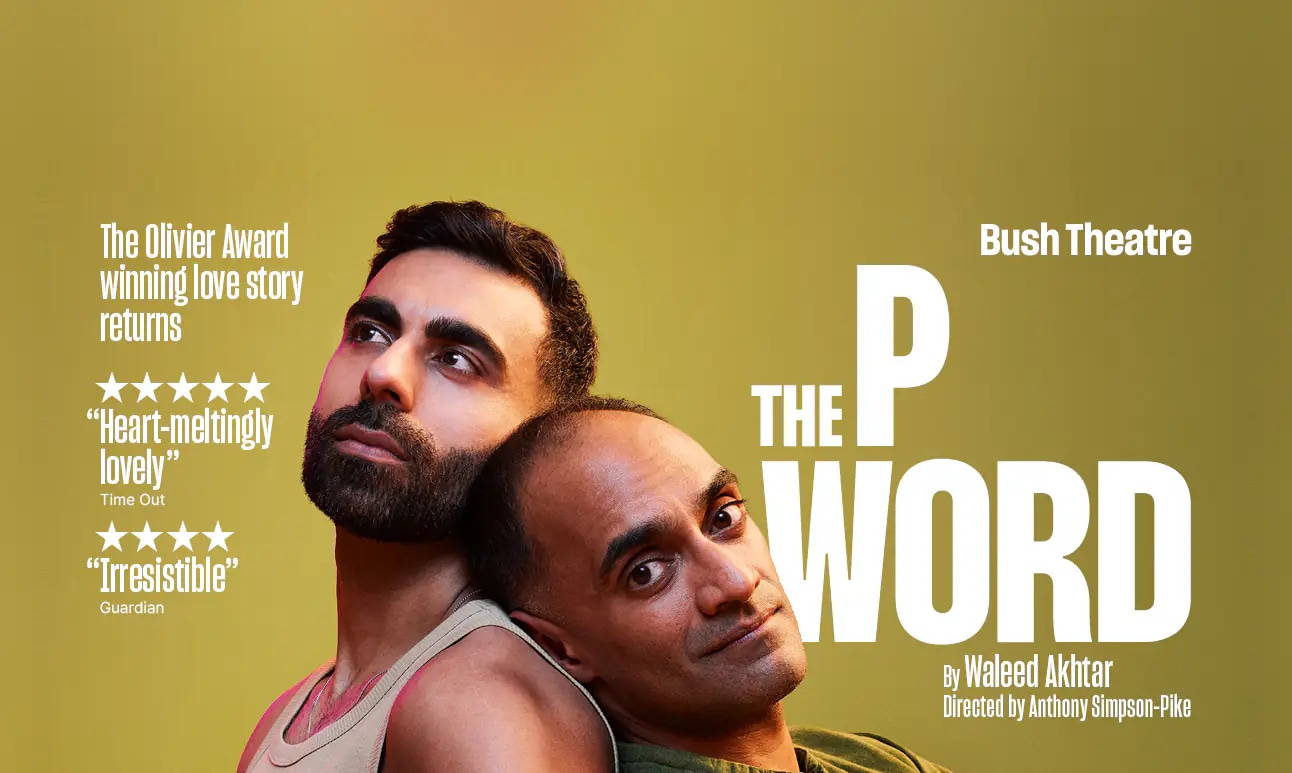
Following its Olivier Award win in 2023, The P Word returns to Bush Theatre with its original cast. Already an impressive piece of theatre, this revival feels tighter and more confident, with a clearer sense of rhythm and a stronger emotional focus.
Written by and starring Waleed Akhtar, The P Word centres on Bilal, or ‘Billy’ as he calls himself, a second-generation British Pakistani Londoner whose childhood experiences of racism and bullying, failed relationships with men, and the institutional barriers he continues to face in adulthood leave him stuck between identities. He wants to belong, but is never quite sure where that belonging might sit, or who it might be with. At school, at work, on Grindr, and within his carefully managed social world, Billy is constantly performing a version of himself that can pass. The effort wears him down. Each attempt to fit in only deepens his self-loathing and his sense of disconnection. Sex becomes something he turns to repeatedly, but it never quite registers as freedom. It feels more like a way of filling a gap he cannot name.
Esh Alladi’s Zafar offers a stark counterpoint. Speaking with a distinct accent, he tells his story in fragments that gradually build a life shaped by love and loss. His relationship with Haroon is tenderly recalled before it is violently broken apart, followed by Haroon’s death and Zafar’s escape to the UK. The grief sits underneath everything he says, held rather than performed. In Britain, survival comes with its own set of pressures. At the border, he is questioned and tested as officials try to decide whether he is ‘really gay’ to deserve asylum. Later he moves through temporary housing in Hounslow, waits endlessly for a Home Office decision, and eventually faces rejection. By the time he arrives, all he has left is his life itself. Home is gone, contact with family is cut off, and return is not a real option, as being forced back would mean death.
Seen alongside Zafar, Billy’s trajectory gains a different weight. Meeting Zafar, and slowly choosing to stay close to him, shifts something in him. It is a decision he makes for himself, and it opens up a possibility of reconnecting with a culture he has spent years pushing away. What begins to emerge is not resolution, but recognition between two people who have learned to survive in different forms of exile.
At just ninety minutes, the production is tightly constructed. The first half moves between Billy’s and Zafar’s monologues, with small echoes in language and objects gently linking their worlds. When they finally meet during Pride in Soho, the structure opens into a more fluid exchange of dialogue and monologue. What they say to each other often sits alongside what they reveal directly to the audience, and that gap becomes one of the most compelling elements of the production. Their differences are clear, shaped by culture, religion, class and lived experience, yet what gradually takes hold is a shared emotional vocabulary. The distance between them slowly shrinks, replaced by a quiet familiarity, the sense that they have each found someone who understands something essential about them.
After saving Zafar from a deportation flight, the two share a final Bollywood-style, almost cinematic kiss. The production then breaks the fourth wall. The actors step out of the story and speak directly about the realities faced by LGBTQ+ asylum seekers in the UK, before asking audience members for their names. The shift from fiction to reality is sudden, but effective. It collapses the distance between stage and audience, and insists that what has been seen does not end with the performance.
Compared with the 2022 production, this version feels leaner and more focused. The performances are more controlled, and moments that once leaned towards excess are now handled with a lighter touch. The relationship no longer reads simply as attraction. It is grounded instead in recognition, in two people seeing their own loneliness reflected back at them.
As an East Asian immigrant and queer audience member, I found many of the play’s tensions and contradictions familiar in many ways. While the context is specific, the questions it raises about belonging, shame, and the search for home travel far beyond it.
Anthony Simpson-Pike’s direction is precise and restrained, allowing the performances to carry the emotional architecture of the piece. Max Johns’ set is equally controlled: a divided circular space that quietly holds the tensions the play continually tries to cross.
The P Word is at Bush Theatre, until 27 June.