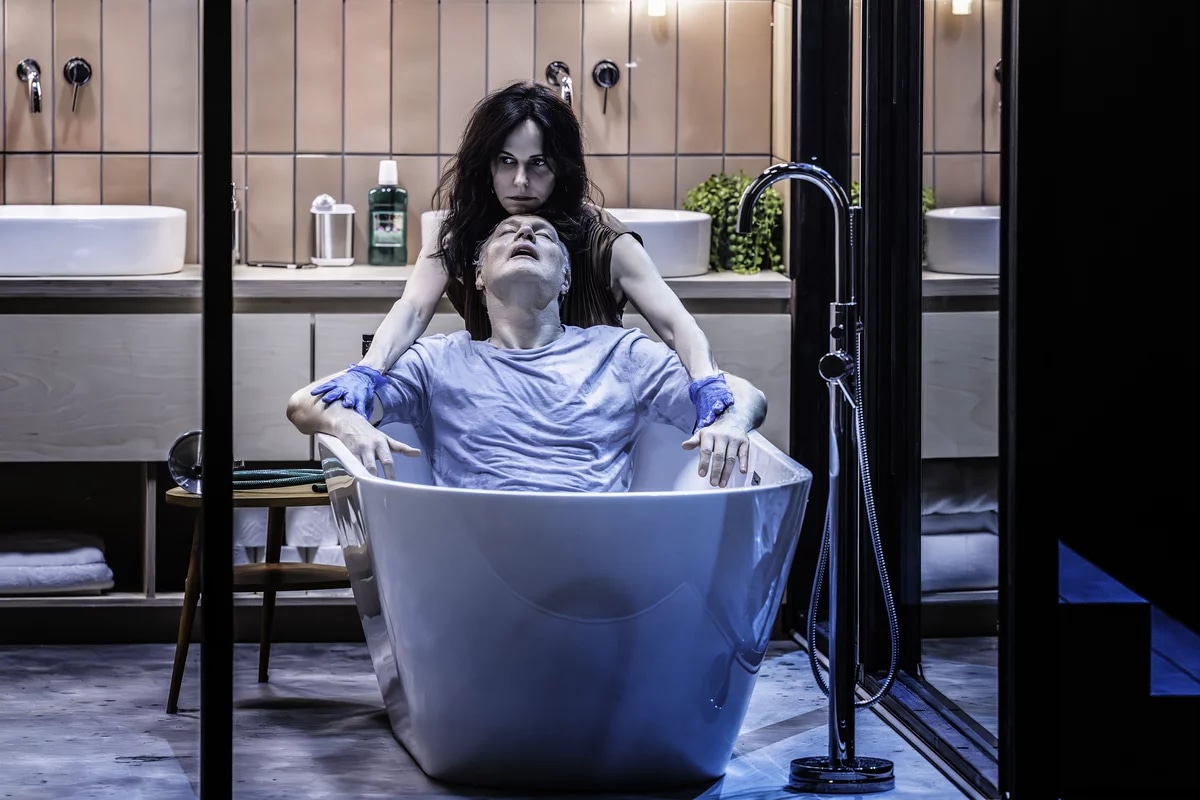
Mary Louise Parker and David Morrissy. Image by Johan Persson
Review by: Flynn Ng
Rating: ★★★★
Running for three and a half hours, including two intervals, Simon Stone’s new adaptation of The Oresteia is an ambitious reinvention of Aeschylus’ ancient tragedy. Even after a substantial cut of around an hour, the production remains a huge theatrical undertaking, unfolding more like a television thriller than a conventional stage tragedy. Through shifting timelines, hidden secrets and gradual revelations, it keeps the audience engaged with the question of what really happened. At its strongest, it captures the destructive power of inherited trauma and explores how revenge functions in a world shaped not by gods, but by human choices and systems of power. However, despite its impressive scale and strong performances, the production sometimes struggles to achieve the emotional complexity of the original tragedy, relying heavily on lengthy monologues to explain characters’ inner conflicts rather than allowing them to emerge naturally through action.
Aeschylus’ original trilogy, Agamemnon, The Libation Bearers and The Eumenides, follows the violent cycle of revenge within the House of Atreus. Agamemnon sacrifices his daughter Iphigenia before setting out for the Trojan War, leading his wife Clytemnestra to murder him with the help of his cousin Aegisthus. Their son Orestes later kills his mother to avenge his father, before facing trial for his actions. Stone retains the basic structure of the original story while moving it from ancient Greece to the modern world.
Here, Christopher becomes the Agamemnon figure, a powerful technology company CEO whose products are used in warfare and sold to Russia, indirectly contributing to the deaths of innocent civilians (obviously inspired by Arthur Miller’s All My Sons). His wife Montie takes the role of Clytemnestra, while their children Augie and Alice parallel Orestes and Electra. Their twin sister Isabel occupies the place of Iphigenia, although her story is significantly transformed.
The play opens with the family preparing for the birthday of Alice and Isabel. Everyone is waiting for Isabel to arrive, and what initially appears to be a small delay gradually becomes something much more devastating. Isabel’s death becomes the defining trauma of the family. Although her death is self-inflicted, the play presents it as deeply connected to the consequences of Christopher’s actions and the world his decisions have created.
Following Christopher and Montie’s divorce, Montie begins a relationship with Jerome, Christopher’s cousin. Together, they invite Christopher and his new partner Chandra to dinner, where they murder him and stage his death as suicide, believing they are taking revenge for Isabel. However, Chandra refuses to accept the official explanation. After being drugged, she struggles to communicate what she knows and is eventually sent to a psychiatric hospital. Like Cassandra in the original tragedy, she becomes someone who sees the truth but is not believed.
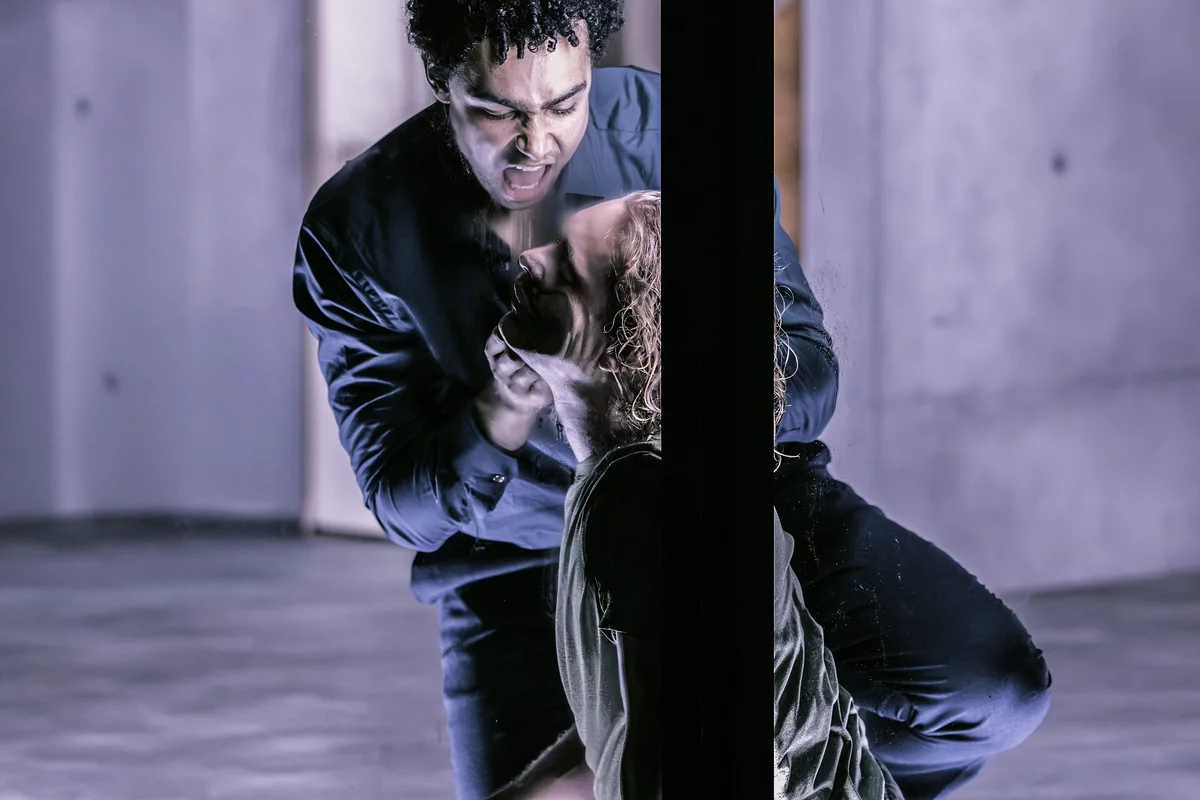
A few years later, Alice begins investigating Christopher’s death, following Chandra’s clues and eventually leading Augie to discover the truth. Having returned from military service, Augie decides to seek revenge against his mother and Jerome. Yet the violence only creates further destruction. During the confrontation, he accidentally kills Alice and eventually collapses under the weight of his own actions. The teenager introduced at the beginning of the play, playing guitar and sharing conversations with his sister, gradually becomes someone haunted by his father’s ghost and consumed by revenge.
Stone also reimagines the relationship between Orestes and Pylades through Augie and Lorenzo, Jerome’s son. In Aeschylus’ tragedy, Pylades is Orestes’ closest companion during his pursuit of revenge, a relationship that has often been examined through a queer lens. In this adaptation, however, their connection is distant and unresolved. Their suppressed intimacy only surfaces shortly before Lorenzo’s wedding, when the two share an unexpected kiss in a bathtub. Rather than offering escape from the family’s violence, the moment reveals another layer of desire and conflict within the same cycle of guilt and repression.
One of the most significant changes in Stone’s adaptation is the disappearance of the gods. Artemis, Apollo, Athena and the Furies are removed completely, and there is no divine intervention to restore order. Instead, the forces shaping this tragedy are modern ones: war, technology, capitalism, media and psychological trauma. Without the gods, there is no external authority deciding who is guilty or innocent. The characters are left struggling with responsibility in a world where blame is complicated and difficult to separate.
This change also reshapes the moral foundation of the original story. In Aeschylus’ Oresteia, Clytemnestra’s revenge is rooted in the clear violence of Iphigenia’s sacrifice. In Stone’s version, Christopher’s responsibility is far more ambiguous. He is connected to Isabel’s death through the consequences of his actions, but Montie’s revenge cannot restore what has been lost. Instead, it creates another chain of violence, leaving the family trapped in the same destructive pattern.
Stone structures the production across different periods, moving between 2016, the Covid pandemic and the present day. The story repeatedly returns to the same events from different perspectives, slowly revealing information that was previously hidden. At first, this fragmented structure creates a strong sense of suspense and allows the audience to gradually piece together the truth. However, within a three-and-a-half-hour structure, the constant movement between timelines gradually becomes exhausting.
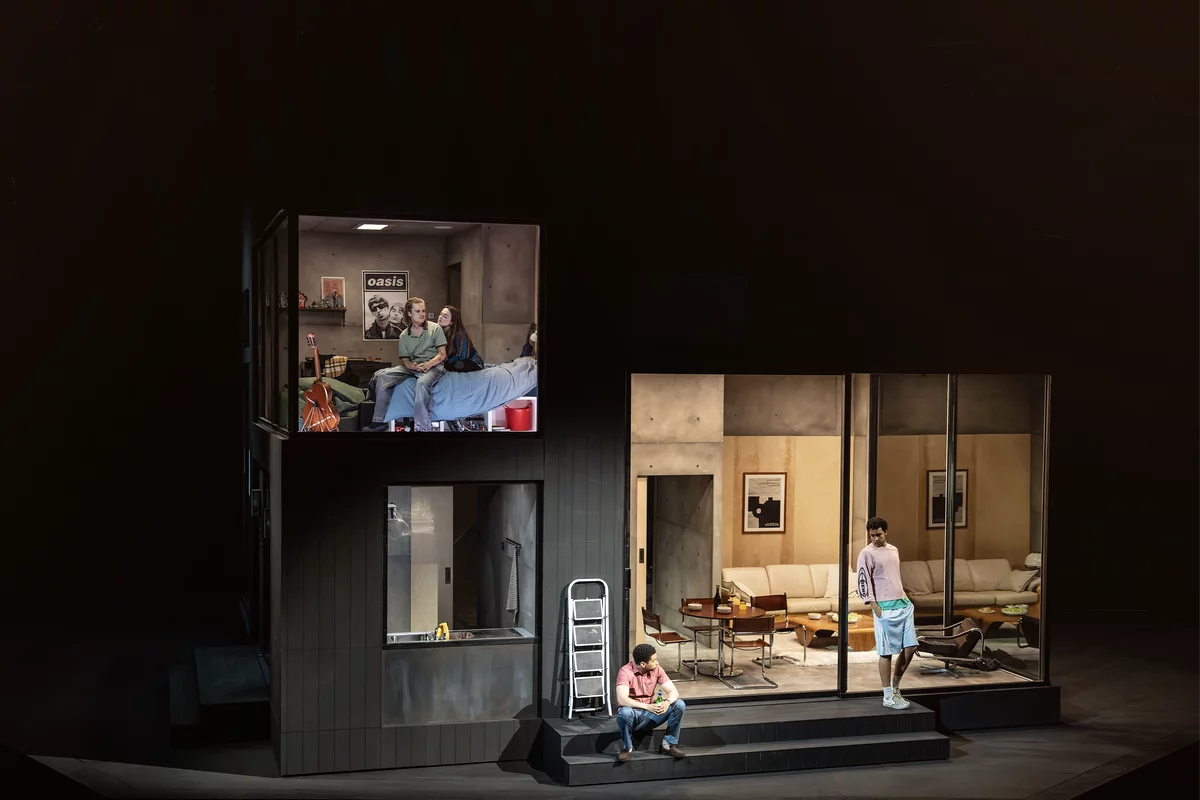
Lizzie Clachan’s set design is one of the production’s most impressive elements. A complete house, with a master bedroom, bathroom, kitchen, living room and an upstairs bedroom, sits on a revolving stage. The design resembles a giant doll’s house, and each rotation reveals another part of the family’s hidden history. Combined with Stone’s shifting timeline, it creates a striking image of a family repeatedly returning to its own trauma.
However, the same design also creates emotional distance. Because the house is enclosed by glass, many scenes feel separated from the audience, as if we are observing the family’s collapse from outside. This becomes particularly noticeable during the frequent arguments throughout the production, where characters often speak over one another. Instead of increasing emotional intensity, these moments sometimes make the drama difficult to follow.
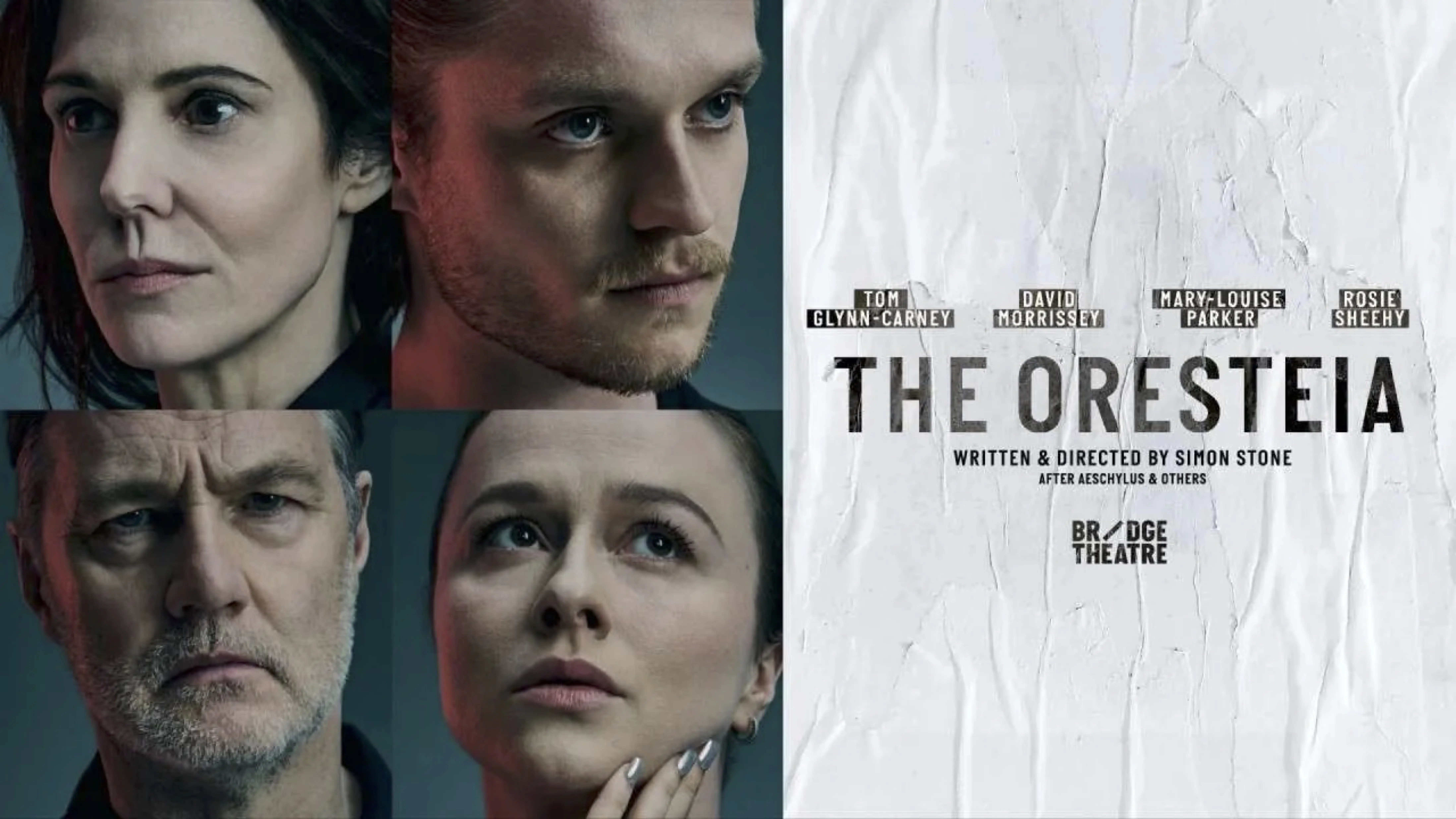
The performances remain one of the production’s greatest strengths. Mary-Louise Parker gives Montie both determination and vulnerability, revealing the exhaustion beneath her desire for revenge. David Morrissey brings complexity to Christopher, allowing him to remain a powerful presence even after his death. Tom Glynn-Carney convincingly portrays Augie’s transformation from a sensitive young man into someone destroyed by violence, while Rosie Sheehy brings warmth and emotional clarity to Alice (and Isabel in the end). Together, the cast creates a convincing portrait of a family shaped by loss and unresolved conflict.
Stone’s The Oresteia is an ambitious attempt to bring one of the foundations of Western tragedy into a contemporary world. Its thriller-like structure makes the story accessible and compelling, while its strongest moments reveal how questions of guilt and revenge continue to resonate. Yet the production occasionally sacrifices emotional depth for narrative momentum. Without the gods, what remains is a tragedy created entirely by human beings, their choices and their inability to escape the consequences of their actions.
The Oresteia is at Bridge Theatre, until 19 September.