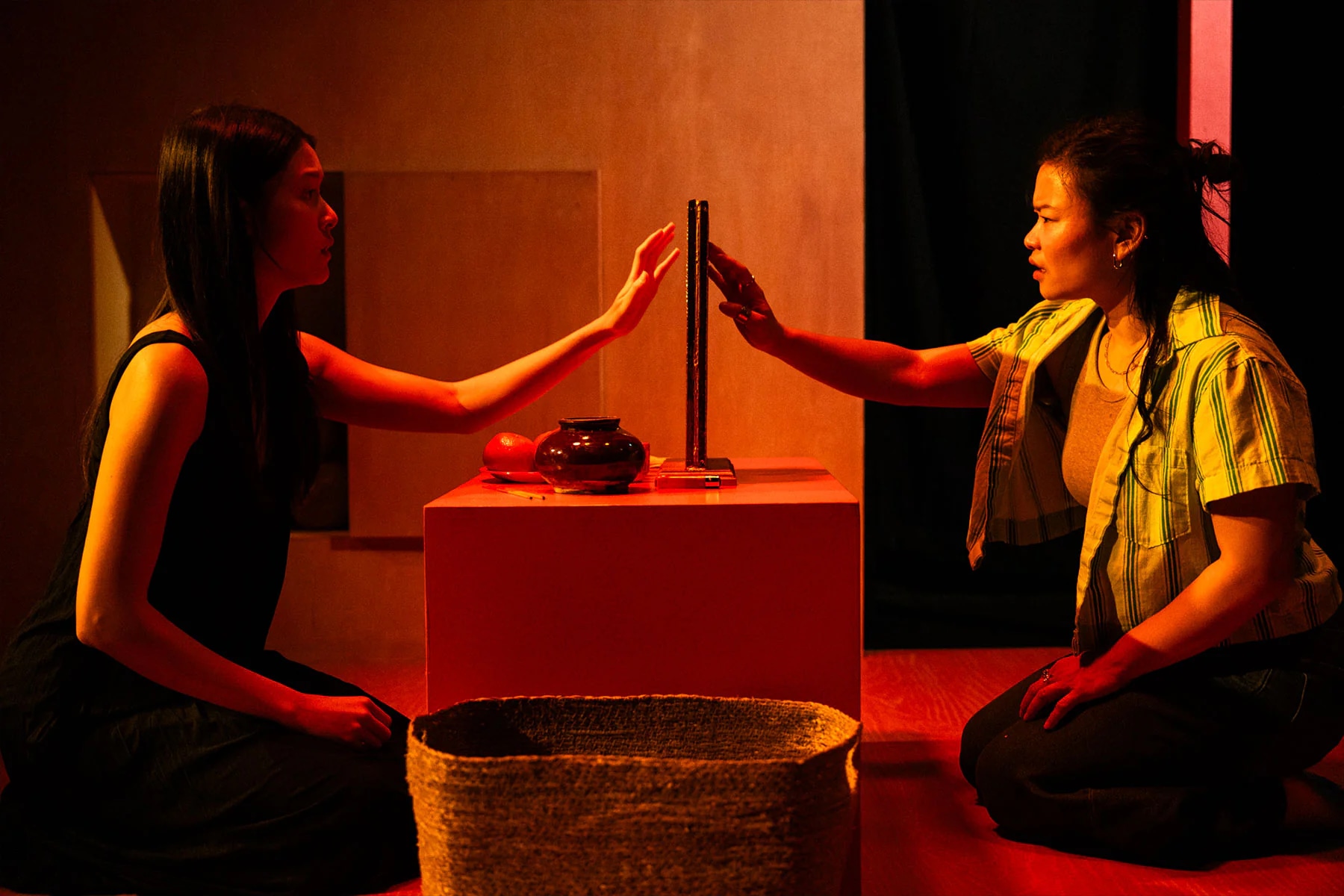
Image by Corinne Cumming
Review by: Flynn Ng
Rating: ★★★★
Listen to a track that fits the mood
There could hardly be a better time for The Hungry Ghost to arrive at the Bush Theatre than October. Set during the Chinese Ghost Month, Mei Leng Yew’s debut play blends queer romance, family tensions and supernatural horror with a sharp sense of humour. Beneath all the hunger for food, sex and chaos, however, lies a more intimate story about coming out, leaving home and confronting the fears we carry with us.
Girl has been dating her girlfriend, Naomi, for three months, and they are ready to move in together. There is just one problem: Girl has yet to tell her parents either that she is gay or that she plans to leave home. Her mother warns her that it is the first day of Ghost Month, an inauspicious time for major decisions and new beginnings. She also tells her not to pick up money from the street. Girl ignores both warnings and soon finds herself possessed by a hungry ghost whose appetite seems impossible to satisfy. What begins as an insatiable hunger for food soon extends to sex, threatening to consume her relationship with Naomi as well.
Yew’s writing is witty, particularly in the bilingual exchanges and the small, awkward moments where cultural differences come into play. The humour often comes from the subtleties of these encounters, rather than from simply explaining one culture to another. These moments feel recognisable and sharply observed, and many of the jokes land beautifully. The comedy also makes the more unsettling moments all the more effective.
As a two-hander, the production asks a great deal of its two performers. Mei Mac is particularly impressive, switching between Girl and the many people in her life, from her mother and Naomi to her secretary, a policeman and her brother. Each character has a distinct voice and personality, and Mac moves between them so effortlessly that it is easy to forget that all these roles are played by the same person. Her comic timing brings out the best in Yew’s writing, while subtle changes in physicality help distinguish each character without interrupting the flow of the story.
Isabella Wei makes an equally strong impression as the hungry ghost. With her long hair, elongated limbs and black dress, she looks every bit the traditional female ghost. Yet her performance goes beyond the striking visual image. She moves in and out of Girl’s space with an unsettling fluidity, working in close synchrony with Mac as the boundaries between the two characters begin to blur. Wei is often funny, but when the ghost turns angry, her expressions can be genuinely frightening. The chemistry between the two performers is central to the production’s success.
Adrianna Kei also gets a big laugh when she appears in a Sainsbury’s jacket to clean up the mess Girl has left behind, wearing an expression of complete exhaustion with the world. It is a wonderfully mundane response to the supernatural chaos unfolding around her. As an understudy who also helps pass props backstage, Kei has a demanding role in keeping the production running smoothly.
Director Ailin Conant handles the pacing particularly well, balancing the comedy with moments of genuine horror. Sudden scares punctuate the lighter scenes, while the physicality of the performances gives the supernatural elements an immediate, visceral quality. Yimei Zhao’s set design is another delight. Rather than recreating a series of realistic locations, the production uses a pink wooden backdrop fitted with cupboard doors. These open throughout the show to reveal an assortment of props, including pomelos. The simple but playful design keeps the action moving while leaving room for unexpected surprises.
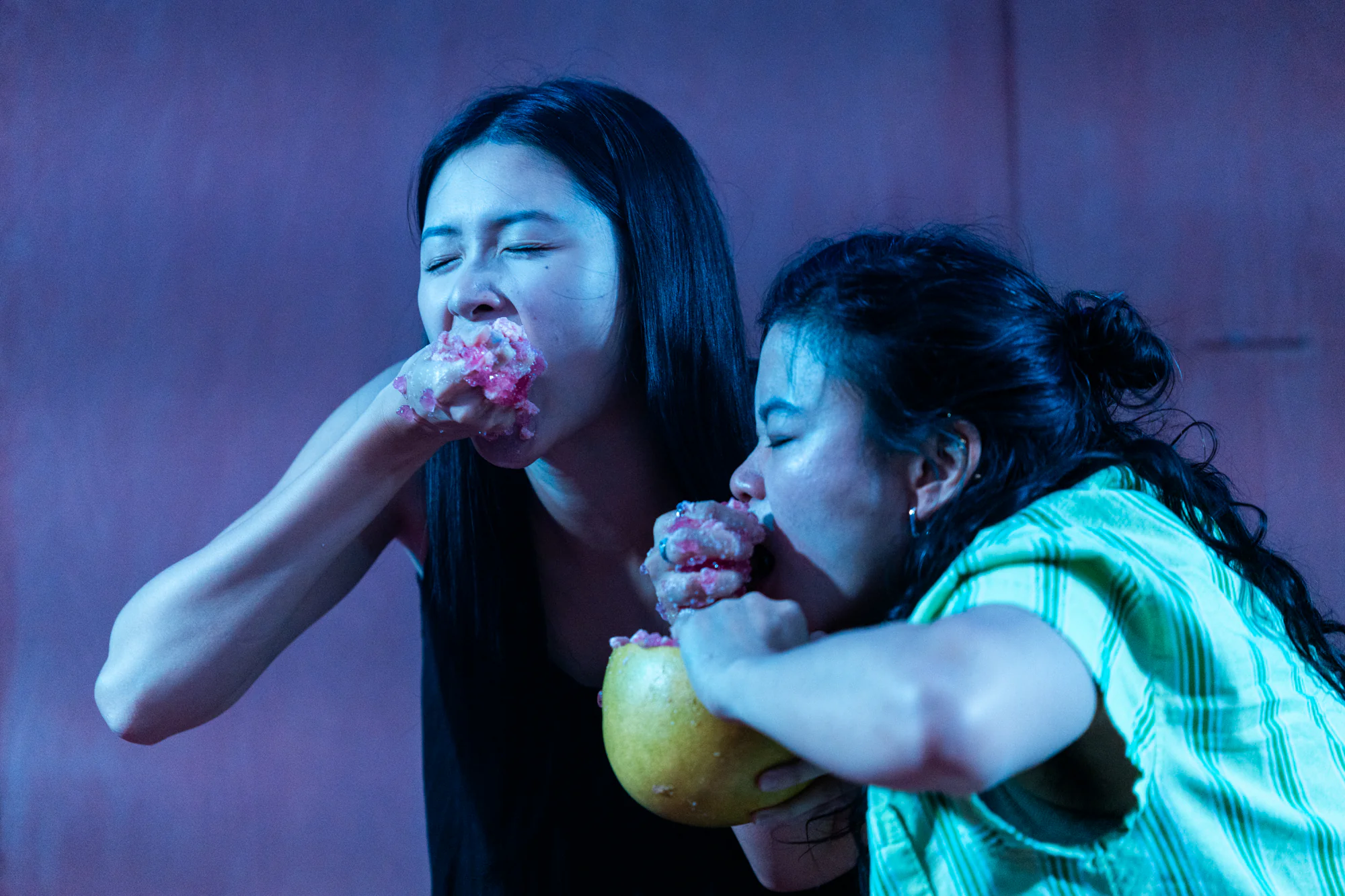
The play takes a darker turn when the ghost recalls her life with 芸妮, the woman she loved, and the circumstances of her death. At this point, my imagination took an even darker turn. I wondered whether she might have been forced into a ghost marriage, which would have given her resentment an even more tragic source. Thankfully, Yew does not take the story in quite such a cruel direction. Even so, the ghost’s past introduces a note of genuine sorrow beneath the comedy, giving her hunger an emotional weight beyond its supernatural premise.
For me, one of the play’s most interesting questions is whether the ghost represents more than an external force possessing Girl. Could she also embody Girl’s internalised homophobia and her complicated relationship with her Chinese identity? Even before the possession, Girl struggles to tell her family about Naomi and repeatedly tries to keep her relationship separate from her family life. Yet when her family, particularly her mother, eventually learns the truth, their reaction is far less hostile than Girl seems to expect. Perhaps the obstacle lies partly in what Girl has been taught to fear, rather than in how her family actually feels. Her inability to speak Cantonese before the possession, and the language’s growing presence once the ghost takes hold, also invite questions about the connection between language, identity and belonging.
Not every cultural reference needs to be fully understood for the emotional story to resonate. Some of the play’s more culturally specific elements, including the traditional Chinese narrative structure of 起承转合, may mean different things to audiences from different backgrounds. Anyone who does not understand Cantonese will inevitably miss some of the finer jokes. As someone who does, I was glad to catch them. I have often watched plays from other cultural contexts and found myself missing certain references, so it was a pleasure to experience the reverse. New Earth Theatre deserves credit for bringing such a culturally specific story to the stage without feeling the need to explain everything to an unfamiliar audience.
Cross-cultural theatre inevitably means that audiences will take different things away from the same production. Not every reference will translate, and not every detail needs to. That is part of the appeal: we bring our own experiences to a story and find our own ways into it. My particular takeaway from The Hungry Ghost was that, after all the supernatural appetites, family tensions and existential dread, I wanted to go home and have a bowl of chicken soup. Sometimes, the best way to settle a hungry ghost is to feed the living.
The Hungry Ghost is at Bush Theatre, until 31 Oct.