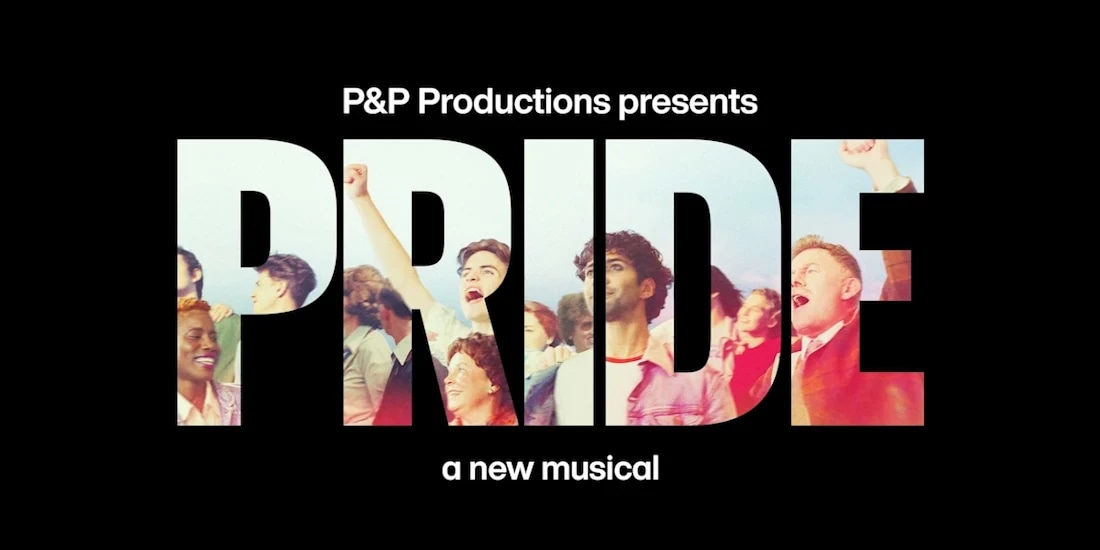
Image by Rich Lacos
Review by: Flynn Ng
Rating: ★★★★
The Dorfman Theatre at the National Theatre was completely full for Pride. Around me, people were quietly wiping away tears, and the applause at the end lasted a long time. The audience covered a wide age range: some were old enough to have lived through those years, while others were born much later. Yet, as the miners and gay activists marched together in the Pride parade on stage, those tears felt like they were about more than just history.
It is hard not to be moved by this story. Pride was originally a 2014 film, now (finally) adapted into a stage musical. The movie was already great, but the transition to the theatre feels surprisingly natural. Instead of just singing through the film script, the production uses music, live acting, and the stage space to bring this history back to life.

Image by Rich Lacos
The story takes place in the UK in 1984. As tensions between the Thatcher government and working-class communities grew, British miners started a strike that lasted nearly a year. Meanwhile, during the London Pride parade, a group of gay activists decided to raise money for the striking miners and formed LGSM (Lesbians and Gays Support the Miners).
Then came an awkward situation: the miners' union refused to accept their help simply because of who they were.
Instead of giving up, the activists decided to bypass the union and go straight to the families. They drove down to a mining village in South Wales, bringing money and supplies directly to the locals. Two groups from totally different worlds, who even held prejudices against each other, walked into each other's lives for the first time.
One group was fighting for their jobs and livelihoods; the other was fighting for their identity and dignity. Under heavy government pressure, they slowly realized they were facing similar struggles, eventually forming an alliance that almost no one could have imagined at the time.
The mixed reactions within the mining community are a highlight of the story. Some locals were open to talking with these activists from London, while others firmly rejected them. But their first real connection actually happened on a disco dance floor in the local pub. People from completely different backgrounds let their guard down through music and dancing, coming closer in an unexpected, relaxed atmosphere. The scene does not try too hard to be emotional, which makes the shift from awkward strangers to understanding each other feel real and visible.
As one of the central figures, Mark is played by John Lumsden, and the casting feels spot on. He carries an unstoppable energy as a true activist. His passion, idealism, and drive inspire everyone in the group, making him the real heart of the organization.
Because of this, his death feels exceptionally heavy. Mark Ashton died of AIDS-related complications in 1987 at just 26 years old. His short life coincided with the most important years of the movement, but his impact went far beyond his lifespan.
Samuel Barnett’s Jonathan is completely different. As an actor himself, he is one of the most dramatic and outgoing characters, bringing a stage presence wherever he goes. His cabaret act at the start of the second half made the whole theatre burst into wild applause. But behind all the showmanship lies a painful reality of the time: Jonathan was one of the first people in the UK diagnosed with HIV. His humour and dramatic personality were not just for laughs; they were his way of dealing with fear and reality.
Lewis Cornay’s Bromley shows a different kind of growth. As the youngest in the group, his journey goes from curiosity to accepting his identity, and finally to his parents discovering his sexuality and reconciling with him. His story is not as grand as Mark’s, but it feels very real. For a young person, figuring out who you are is often a long battle in itself.
Beyond the characters, what makes this play truly moving is that it does not treat the two groups simply as ‘givers’ and ‘receivers’. Both the miners and the gay activists enter this relationship with their own prejudices, fears, and vulnerabilities, and both change each other along the way.
In the second half, the women from the mining village visit London, going to a gay bar for the first time and attending LGSM’s fundraising concert, ‘Pits and Perverts’. The title itself is a statement. ‘Pits and perverts’ was originally an insult used against miners and gay people, but LGSM took the words back and used them for their own cause. Reclaiming the language meant to hurt them echoes how the word queer was later reclaimed by the LGBTQ+ community.
The final Pride parade is one of the most memorable moments in the play.
LGSM was originally asked to march at the very back of the parade. But as miners arrived from all over the country, their numbers quickly surpassed the LGSM members. The people who were once told they ‘didn't belong here’ were pushed to the very front of the crowd.
It looks almost like a fairytale.
But the most moving part is that it was not a fairytale.
It really happened.
Sitting in the theatre and watching this real history from the 1980s brings up a complicated feeling. If such a moment actually happened back then, has the more open and united future we hope for today already come and gone?
The musical handles the shift from screen to stage very well. With book and lyrics by Stephen Beresford and music by Christopher Nightingale, Josh Cohen, and DJ Walde, the original story gets a new life. The pacing, songs, and acting are all strong. The music never feels out of place; instead, it becomes part of how the characters express themselves and act together.
The opening songs of both halves show a clear difference between stage and film. While movies rely on camera angles, editing, and scene changes to move the story forward, a musical builds its pace through actors, live music, and the physical space. Pride does not feel like a simple stage copy of a movie, but a true adaptation for the theatre.
I would love to give this show five stars without hesitation. But if I had to find a flaw, I wish the lesbian characters had been given more room in the story.
After all, the group is called Lesbians and Gays Support the Miners.
The main lesbian character, Steph, has a clear presence, but her most memorable moment is probably when she uses the fire extinguisher. Compared to Mark, Jonathan, or Bromley, who have clear character arcs and big moments, her storyline feels smaller. Steph is not unimportant, but when a play centres on an organization that clearly names both lesbians and gays, I cannot help but ask: why is the space for lesbian characters still so limited?
If the play had included more of their stories and voices, this narrative about different groups supporting and changing each other would feel even more complete.
This does not change how much I like the show; it is just a small regret I kept thinking about after leaving the theatre.
It also made me think of Gay's the Word in London.
Located near Russell Square, Gay's the Word is an important meeting spot and safe place in the story. In real life, the bookstore was even attacked in the past. I have been there a few times myself. It is actually very quiet, but it carries a strong sense of history. Standing there, you realize that people once gathered, argued, organized, loved, and felt scared in that exact place. You almost feel like you are becoming a part of that history too.
Because of this, what saddens me most about Pride is not that it tells a story of a past era, but that looking back at these ‘glory days’ makes me wonder if they are truly behind us.
Society today seems to be turning conservative again. Debates over gender, sexuality, and identity are getting sharper. Looking at modern works that constantly discuss toxic masculinity, gender anxiety, and identity politics, we realize that many problems from forty years ago have not disappeared. The issues we thought we had moved past just show up in different ways.
So when the miners and gay activists stand together at the end, and that almost impossible alliance appears on stage, it brings up a painful question:
Have we really been moving forward?
Perhaps Pride is worth staging today not just because it tells a story worth remembering.
It matters because it reminds us that things which sound like fairytales actually happened in real life.
In a time when the government cracked down on workers and the gay community faced constant violence and discrimination, two completely unrelated groups chose to stand together. They were different, but facing oppression together taught them to understand each other.
If an alliance like this existed before, it should not only belong to the past.
Maybe this is the most touching part of Pride: it makes us cry for what happened, while forcing us to think about whether we can still stand together next time.
Pride is At the Dorfman theatre, National Theatre until 12 September, before transferring to the Bridge Theatre from 12 November 2026 to 8 May 2027.