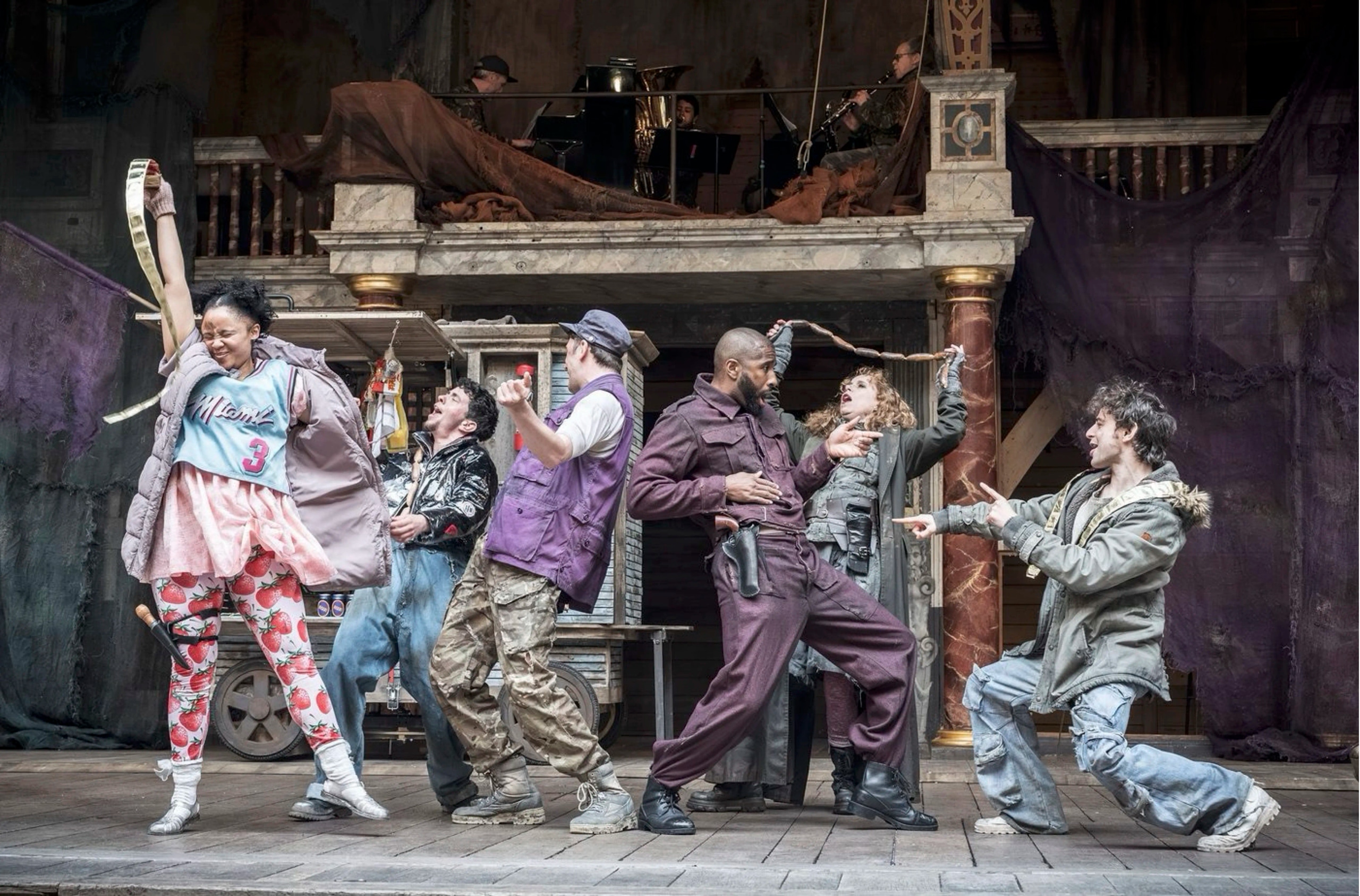
Image by Marc Brenner
Review by: Flynn Ng
Rating: ★★★★
Mother Courage and Her Children Review: Too Involved to Distance

There is something unexpectedly fitting about seeing Shakespeare's Globe stage Bertolt Brecht’s great anti-war epic. The open-air architecture, the constant visibility of the audience, the porous boundary between stage and world, all of it feels strangely aligned with Brecht’s theatrical language, even if the emotional effect produced here ultimately moves in the opposite direction of his famous theory of distanciation.
The story is well known. Mother Courage follows the war with her cart. She sells bread, alcohol, clothes, meat and weapons to soldiers. She survives through war, but loses everything to it. The main contradiction is clear. She rejects war, but also depends on it.
The final scene at the Globe is very strong. After losing all three children, Mother Courage slowly drags her cart across the extended stage and prepares to follow the army again. As she walks, rain suddenly falls into the theatre. Some audience members are in tears. Above the stage, planes and birds cross the sky. For a moment, it is hard to tell where the performance ends and the real world begins.
This moment goes against Brecht’s theory. Distanciation is meant to stop emotional immersion and create critical distance. But the open space of the Globe works differently. Weather, city sound, and aircraft all enter the performance. War does not feel like history or symbol. It feels present.
Michelle Terry gives a clear and controlled performance as Mother Courage. She shows the character’s strength and survival instinct. At the same time, small moments of vulnerability appear. Each time she finishes a sale and says ‘Cha-ching!’, we understand the cost behind it.
The three actors playing her children are also strong. Vinnie Heaven plays Eilif with confidence and a clear attraction to violence. Rawaed Asde makes Swiss Cheese honest and naive. Rachelle Diedericks’s Kattrin is the emotional centre of the production. She never speaks, but she shows strong care for others.
Nadine Higgin plays Yvette with energy and warmth. Her musical scenes about past love are vivid and full of life.
Director Elle While and translator Anna Jordan move the play into a near-future setting. They also tighten the text. The story includes drones and colour-coded military groups. Blue and purple banners hang above the stage to show changing power. At the end, after a short peace, a new orange faction appears. The cycle starts again.
The point is simple. Mother Courage is not about one war. It is about war as a permanent condition.
The music by James Maloney is one of the best parts of the production. The jazz-folk style is rough and direct. One moment is especially strong. Eilif sings a song in front of the General, while on the other side of the stage Mother Courage sings the same melody in the kitchen space at the same time. This moment removes the large political scale and shows something more personal. It is a shared moment across the stage space.
Brecht wrote the play in 1939, the year World War II began. The play is set during the Thirty Years' War, but its world still feels close today. It shows a society where war, trade and survival are mixed together.
This Globe production does not try to force a new meaning onto the play. It lets the play speak for itself. By the end, the rain, the planes above, and Mother Courage pulling her cart all feel part of the same world. We are not allowed to sit back and analyse war from a distance. Instead, we stay in the rain with Courage, aware of her cart and her endless movement. The theatre does not give distance. In refusing distanciation, it creates something stronger. It makes us see that outside the Globe, the world still turns violence into profit, and the rain still falls on a world that does not change.
Mother Courage and Her Children is at Shakespeare’s Globe, until 27 June.