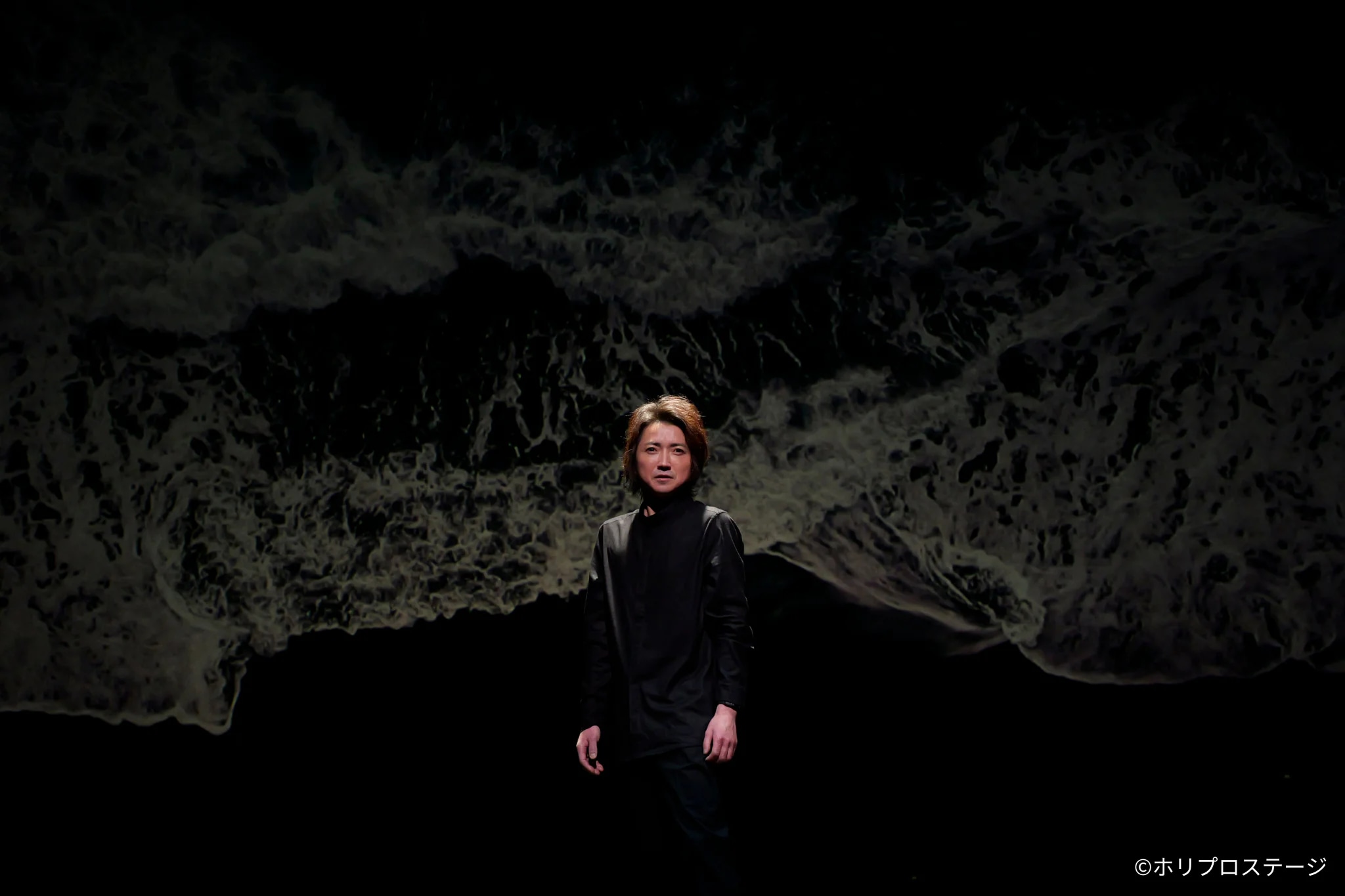
Image by Takahiro Watanabe
Review by: Flynn Ng
Rating: ★★★★
A mysterious creature’s bones, a leading biologist, a potential breakthrough in human evolution, and a protagonist caught between worlds. Sound familiar? Well, this is not NODA MAP’s –320°F. It is End of the World and Hard-Boiled Wonderland, a stage adaptation of Haruki Murakami’s 1985 novel, directed and choreographed by Philippe Decouflé and adapted by Ako Takahashi.
The story unfolds across two parallel worlds. In Hard-Boiled Wonderland, Watashi works as a Calcutec, a specialised data processor who becomes caught up in a series of events following a commission by the Professor.
In the End of the World, Boku lives in a walled town where unicorns and townspeople coexist peacefully. To enter the town, he must give up his shadow. He later discovers that his shadow is tied to his heart and his capacity to feel emotions and love. In the town library, the skulls of unicorns preserve the townspeople’s old dreams, which Boku alone can read as the designated dreamreader.
As the story unfolds, Watashi’s memories of the two worlds begin to merge, and the boundaries between them grow increasingly blurred. The storylines eventually reach very different endings. In the End of the World, Boku chooses to say goodbye to his shadow and live with the library girl in the forest, accepting a difficult and imperfect life together amid the heavy snowfall. Watashi, meanwhile, faces the fact that his time is running out and that his consciousness is destined to enter the other world. Together, the endings bring the novel’s questions about memory, identity and emotional connection into focus, offering two different perspectives on what it means to be human.
The stage adaptation cuts much of the original material while retaining its central narrative. Through movement, music and inventive stage design, Decouflé brings Murakami’s strange universe to life. The production’s greatest strength is its visual imagination. Rather than trying to explain every detail of the novel, it captures its dreamlike logic through physical theatre and striking stage images.
The unicorns are a particularly clever example. The ballet dancers move on tiptoe, each holding two extra legs in their hands, transforming themselves into the four-legged mythical creatures. This simple but effective technique gives the unicorns an uncanny, otherworldly quality. In the second half, a rain sequence featuring transparent umbrellas (so typical Tokyo) is equally graceful, turning an everyday object into an elegant piece of choreography. The scene also brings to mind Singin’ in the Rain, with its playful use of umbrellas and movement.
One of the production’s most moving moments comes when Boku confesses his love to girl from library and promises to help her find her heart, scattered among the skulls of many unicorns. As he plays the accordion, the skulls begin to glow and gather around them. It is a beautiful, almost magical image that brings the production’s surreal stagecraft together with its central concern with love. In a world where people are separated from their hearts, Boku’s promise and music give emotional weight to the desire to recover what has been lost.
Decouflé also has a strong sense of comedy. Several scenes draw on the exaggerated visual language of manga. Big Guy and Small Guy appear joined together, and Big guy later wreaks havoc in the protagonist’s home, smashing the door and punching holes in the walls. The destruction is made all the more entertaining by the set, giving the scene the absurdity of a live-action cartoon.
The humour continues when Watashi shares a final meal with She. The waiters’ exaggerated gestures as they take orders and serve the food turn an ordinary restaurant visit into a piece of physical comedy. These moments provide welcome relief from the more abstract and sombre passages without disrupting the production’s distinctive style.
The production also embraces the more unsettling side of Murakami’s imagination. The ritual in which Boku’s eyes are marked so that he can become a dreamreader recalls the disturbing eye-slicing sequence in Luis Buñuel and Salvador Dalí’s Un Chien Andalou. It is a startling image that fits the production’s surrealist sensibility.
Live music is another highlight. Musician Mayu Gonto performs on the piano and other instruments, becoming part of the theatrical landscape. In one scene, the characters visit a power plant and meet its caretaker, who shows them his collection of unusual instruments. With their worn surfaces and fantastical shapes, they look as though they have come from another world. Hearing them played live adds to the production’s dreamlike atmosphere, while also bringing out the importance of music in Murakami’s writing.
The novel is full of references to songs, books and films, reflecting Murakami’s almost encyclopaedic enthusiasm for popular culture. Music here does more than set the mood; it connects the surreal world of the story to the characters’ memories and emotions. A Japanese rendition of As Time Goes By, the song associated with Casablanca, recalls a film Watashi watched with a girl he loved when he was eighteen and she was seventeen. It brings the surreal story back to familiar feelings of love and nostalgia. Towards the end, as Watashi faces his approaching fate, Bob Dylan’s voice fills the theatre, lending the scene a quiet melancholy.
The performances are strong throughout. Tatsuya Fujiwara captures Watashi’s tough exterior and underlying loneliness, while Misato Morita plays the librarians in both worlds, giving each a distinct personality. Her performances help distinguish the two realities while maintaining a sense of connection between them.
Yet the production also brings some uncomfortable aspects of the source material into sharper focus. The scenes in which a seventeen-year-old girl repeatedly asks a thirty-five-year-old man to sleep with her are particularly uncomfortable to watch. Murakami’s writing about intimacy and sex can feel abrupt and difficult to make sense of, with sexual encounters sometimes appearing out of nowhere. The novel’s reliance on the male gaze is also hard to ignore. Female characters are often defined by their bodies, sexuality or relationships with men, and seeing these encounters performed on stage makes these aspects of the writing even harder to overlook.
Ultimately, beneath its science-fiction and fantasy elements, this is a story about loneliness and love, two themes that recur throughout Murakami’s work. Written in 1985, the novel also reflects anxieties about modern civilisation and the growing power of technology. Back then, Watashi jokes about computers having personalities in the future, and today, we’re living in a world where AI is part of everyday life.
And to think about it, if I knew I had only 24 hours left to live, what would I do with them?
End of the World and Hard-Boiled Wonderland is at Barbican, until 11 October.