Image by Aijing Zhong
Review by: Isabelle Wang
Rating: ★★★★
When we enter Camden People’s Theatre, The Sediments of Who We Are does not appear to have begun.
Several tables have been arranged in the foyer. On one, samples of different teas sit in small glass boxes alongside descriptions in English. Their varied shapes, colours and scents correspond to different stories, giving the display the feel of a miniature exhibition. Another table holds teas from different countries and regions. Hot water is ready, and the performers introduce and brew the teas before handing each audience member a different cup to try.
There is no conventional opening cue, no clear moment when we are told to stop talking and prepare for the performance. People drink tea, chat and examine the leaves. The atmosphere is relaxed, comfortable and almost domestic. The performers keep an eye on anyone who has not yet received a drink and slip naturally into conversations with the audience. Everyone is looked after, although few of us realise that this act of care is already part of the performance.
At one point, a performer even asks us to record a birthday message for his brother. It happens so casually that almost nobody recognises it as a piece of planned theatrical action. Only when another performer begins to speak about her grandfather does the audience gradually fall quiet and make space for her. We realise that the performance has been under way for some time.
This unobtrusive beginning is one of the production’s most inventive choices. Rather than abruptly transporting its audience into a fictional world, the piece first establishes a real relationship through a cup of tea. Serving, waiting, chatting and caring for one another are not incidental preparations before the performance proper; they form its opening movement. We do not begin to understand the work only after taking our seats. From the moment we accept a cup, we have already entered its meditation on memory, home and human connection.

Image by Aijing Zhong
The grandfather in the performer’s story is not turned into a legendary figure. The details are simple: he would make her tea, and their conversations might consist of little more than ‘Hello’ and ‘When are you coming back?’ The absence of theatrical embellishment is precisely what makes the memory feel true.
Our sense of home and family is rarely built from dramatic events alone. More often, it resides in gestures repeated so many times that we barely notice them: someone always boiling the water for you, someone always asking when you will return. It is only after leaving that these ordinary moments reveal themselves as some of our strongest ties to home.
The other performers gradually share their own relationships with tea. One, born and raised in Britain, mixes tea and coffee together. Another woman associates ginger tea with her mother. These stories do not search for a single, authentic ‘tea culture’. Tea carries a different flavour in each person’s life. It may belong to a grandparent or a mother, or be remade by combining habits drawn from different places.
The production thereby avoids an obvious trap. It does not treat tea as a fixed symbol of the East, nor does it suggest that anyone must drink it in the ‘correct’ way to prove a cultural identity. Tea can be inherited or altered. It can retain its original flavour or be mixed with coffee. Identity works in much the same way: it is not a pure source waiting to be verified, but something continually steeped and blended through migration, family relationships, personal choices and everyday habits.
The audience is then led downstairs into the basement performance space, and the mood begins to change. In the foyer, tea could be held, tasted and shared. Downstairs, it first reaches us as scent. Before we have properly taken in the room, the rich smell of tea has already enveloped us.
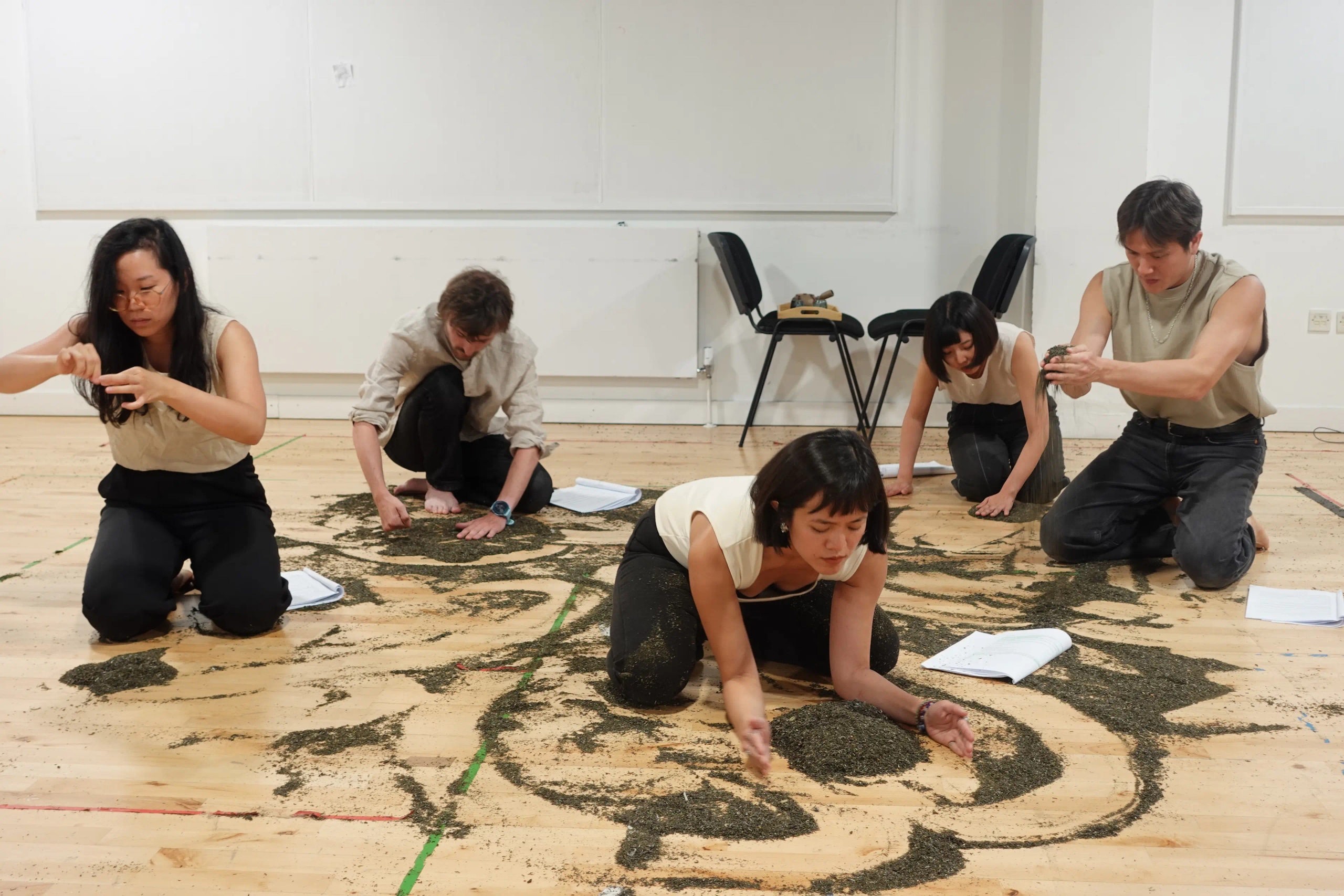
Tea leaves have been arranged across the floor in the shape of East and Southeast Asia. It is a direct visual image, but not an empty one. All five performers now live in Britain, yet the places in which they once lived have not disappeared simply because of geographical distance. Those places remain present through flavour, scent and bodily habit. A daily cup of tea becomes a ritual that can be repeated in another country, briefly bringing distant places back within reach.
Tea is therefore more than a prop to be observed. The audience has already tasted and smelt it, and we carry our still-warm cups as we follow the performers through the building. The production’s ideas about migration and belonging do not remain solely within its spoken text. We are not merely told that tea preserves memory; our own bodies experience the way a taste or smell can prompt association. The map on the floor becomes more than a geographical image. It is a map redrawn through private memory.
A kettle is boiled onstage. The wait is neither cut short nor hurried past. As its sound gradually grows, the five performers enter one by one. Each speaks about their relationship with tea, tracing where they have come from and how they arrived here.
Waiting matters in this sequence. Tea cannot be made without it: water must boil, leaves must steep and flavour needs time to emerge. Identity seems to develop at a similar pace. We rarely arrive at a complete answer to ‘Who am I?’ in a single moment. Past experience enters the present and slowly settles within the body. Some flavours are immediately apparent; others take far longer to recognise.
The five accounts reveal different tea-drinking traditions and five distinct journeys. The production does not rush to organise them into a single, tidy narrative of cultural exchange. It allows their differences to remain side by side. One person remembers a grandfather through tea, another remembers a mother; one rediscovers a sense of home, while another finds a place within mixture itself. Tea connects them without erasing what cannot be generalised.
The question of ‘Who am I?’ in The Sediments of Who We Are is therefore not one with a standard answer. A person may no longer be able to explain themselves through a single place, culture or identity. Leaving somewhere does not mean severing every connection with it; building a life in Britain does not reduce the past to an object of nostalgia. We continue to carry the flavours of different places, while each new experience alters what was already there.
What remains most vividly after the performance may not be a particular line, but the warmth of the cup in one’s hands and the smell of tea that greets us as we enter the basement. The production does not turn identity into a problem that can be definitively solved. It simply allows the fine sediments from which we are made to emerge slowly through water and time.