Review by: Isabelle Wang
Rating: ★★★★
The stage of Maybe Tomorrow initially presents us not with a country in crisis, but with an entirely ordinary home. A rug, a few chairs and a television simply sketch out a living room in which people rest, talk and make plans for the future. It is precisely because this space feels so familiar that the political turmoil and violence that later intrude upon it seem all the more brutal.

Accompanied by a light-hearted tune, a figure with an innocent, childlike air enters the stage. Her delicate, playful movements quickly draw the audience into a relaxed and intimate atmosphere. Yet this sense of ease does not last. The sound of a television news report gradually transforms the mood, and the living room, previously a place of domestic comfort, begins to be occupied by the tension and unease of the world outside.
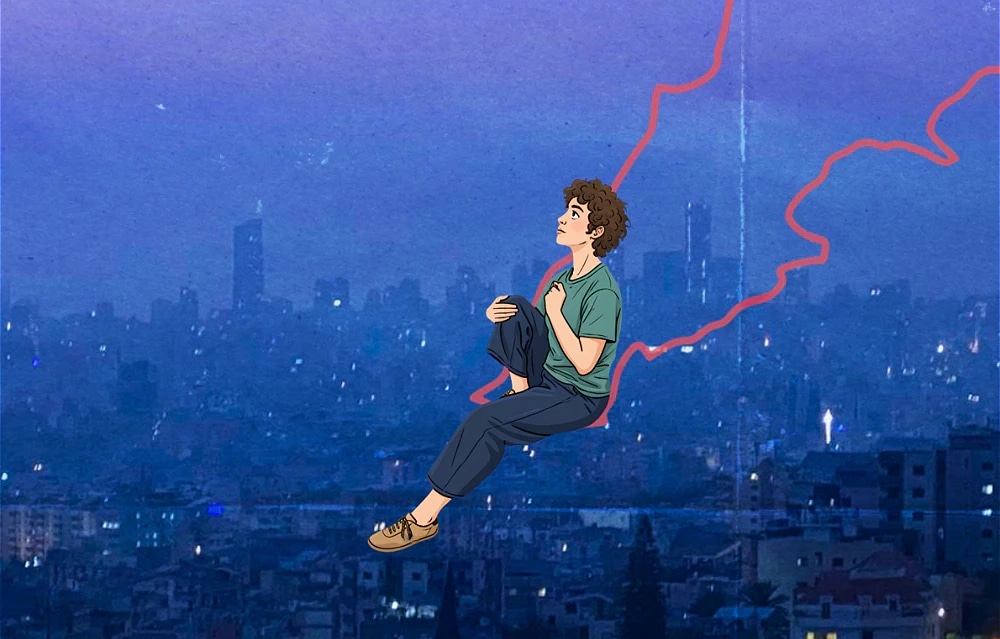
This shift in atmosphere also anticipates the two characters that writer-performer Antonia Chammas will embody through a single body: the sisters Yara and Mina. They possess different personalities and attitudes towards life, representing two radically different responses to the same country and the same predicament.

As the character moves around the stage, the streets beyond the living room appear to unfold before us. The cries of demonstrators, the chaotic soundscape and the steadily increasing tension evoke Lebanon’s social upheaval. The cruelty of this struggle lies in the fact that it no longer belongs to one person or one particular group; it draws in everyone who lives within it.
When a soldier points a weapon at someone old enough to be their mother, the production poses a question without an easy answer: what force makes people who share the same land begin confronting one another with guns?
The world outside is filled with conflict, and life inside the home cannot remain untouched. Yara and Mina are not political heroes, but sisters from an ordinary Lebanese family. Through news reports, demonstrations, power cuts, hospitals and anxiety about the future, the national crisis enters their living room little by little—and begins to shape their relationship.
Mina loves life and longs for freedom. Even after witnessing demonstrations and unrest in the streets, she returns home with an almost childlike enthusiasm for the details of her everyday existence: a friend’s romantic life, whether her nails look good, her plans for the future and her intention to leave Lebanon.
These apparently apolitical concerns do not mean that Mina is genuinely indifferent. On the contrary, her lightness is a form of self-preservation developed through years of disappointment. She has not forgotten what is happening to her country; she understands it all too clearly. No one is going to arrive suddenly and rescue them. Ordinary people have already given everything they can, yet nothing has substantially changed.
Mina understands her elder sister Yara’s revolutionary passion, but she can no longer believe that passion alone will rebuild their lives. She imagines what her future might look like if she remains in Lebanon: returning home with a child in forty-degree heat, only to find that a power cut has stopped the lift and that she must carry the child up seven flights of stairs. She might receive a call saying that a relative has been taken to hospital, yet be unable to reach them because the city’s basic infrastructure has ceased to function. Meanwhile, shells continue to fly overhead, and danger might arrive at any moment.
Leaving, therefore, does not mean that Mina feels nothing for her homeland. It is a decision made from a place of profound powerlessness—an attempt to claim a different kind of life for herself. She is no longer willing to surrender her entire future to a country that cannot guarantee its people the basic conditions of living.
Mina’s choice is entirely opposed to Yara’s. Chammas removes a purple shirt, and with it her physicality and rhythm change. Mina gives way naturally to Yara, who sits on the living-room floor making protest placards. Yara still believes in the necessity of resistance and cannot accept her sister’s decision to leave.
Where, Yara asks, can Mina go? What will she become in another country—a foreigner, an immigrant or a refugee? Can she simply forget her language, her culture, her music and her food? Can she forget who she is?
Lebanon possesses such a rich culture, so much that deserves to be cherished and celebrated. Should that not be enough to make someone stay and fight? Whatever the outcome, good or bad, Yara is neither the first person to dream of rebuilding the country nor will she be the last.
The sisters’ argument is therefore no longer simply a choice between staying and leaving, but a confrontation between two equally genuine forms of pain. Yara believes that if everyone leaves, change will never come. Mina believes that no individual should be expected to sacrifice herself indefinitely while waiting for a future that may never arrive.
Both women love their homeland, yet that love sends them in opposite directions. Yara wants to remain and repair it; Mina must leave before it destroys her as well.
Their disagreement eventually becomes a furious confrontation. Yara insults Mina, and Mina leaves the house in anger. Neither of them anticipates what follows: the Beirut port explosion. Its force finally tears apart the boundary between the living room and the outside world, and Yara can no longer reach her sister.
Only then does the title Maybe Tomorrow acquire its full weight. ‘Maybe tomorrow’ can initially sound hopeful: perhaps the country will change tomorrow; perhaps life will return to normal; perhaps the sisters will understand one another again. Yet it can also suggest an endless cycle of postponement—perhaps there will be electricity tomorrow; perhaps the hospital will be reachable; perhaps the revolution will deliver results; perhaps the missing person will finally respond.
After the explosion, the arrival of tomorrow can no longer be taken for granted.

As a solo production in which one performer plays two characters, Maybe Tomorrow faces a central challenge: Yara and Mina must both emerge as independent, credible people, rather than allowing one to become merely the other’s opposite or supporting presence. Chammas meets this challenge with considerable skill.

The two characters are clearly distinguished through physicality, vocal rhythm and their positioning within the space. Mina’s expression is light and quick, filled with thoughts of personal life and future possibilities. Yara is more focused and resolute; her act of sitting on the floor and making placards also brings the revolution from the streets directly into the home.
The transformations do not depend upon elaborate costumes or theatrical machinery. A simple action such as removing the purple shirt, accompanied by a change in physical and verbal rhythm, is enough for the audience to recognise the new character immediately. Each transition is fluid and does not interrupt the emotional progression of the story.
In structuring the text, Chammas avoids the technical difficulty of staging frequent, rapid exchanges between two characters played by the same performer. Mina is first given the space to express her life and position fully, after which Yara appears and responds. This allows each character to establish a complete internal logic, giving the audience time to understand why one choice has been made before entering the other perspective.
The solo form also gives the production a deeper resonance. Although Yara and Mina are sisters, they resemble two voices within the same person: one still believes that action can bring change, while the other is so exhausted that leaving has become the only possible choice; one insists that the homeland must not be forgotten, while the other asks whether a homeland should not also accept responsibility for those who live within it.
Love and anger, hope and disappointment, staying and leaving are not mutually exclusive emotions. They can coexist within a single person’s relationship with home.
Chammas not only creates two credible and richly developed characters, but also ensures that the production’s dense political concerns remain rooted in everyday life. Colonialism, revolution and migrant identity never remain abstract ideas. They become a lift immobilised by a power cut, a hospital that cannot be reached, one person’s plans for the future and a final argument between sisters that was never properly resolved.
Lauryn Jenkins’s direction gives the production an equally assured sense of flow. The stage retains the basic outline of an ordinary living room throughout, while sound continuously expands the space around it. Light music establishes it as a home; television news brings the political crisis inside; the noise of the streets connects it to the demonstrations; and the final explosion destroys any lingering illusion that the household can remain protected from external danger.

Jenkins does not rely upon elaborate scene changes to emphasise the scale of history. Instead, national events continually act upon the characters’ bodies and their relationship. The living room never moves, yet the audience travels from the sisters’ everyday lives into the streets, and from the hope of revolution towards social collapse and the loss left by the explosion.

Maybe Tomorrow does not ask its audience to decide whether Yara or Mina is correct. Yara’s determination is not naïve, and Mina’s departure is not a betrayal. They are simply responding differently to the same reality: when a country repeatedly fails its people, should someone remain and continue trying to change it, or first save the life they might still be able to build elsewhere?
Perhaps the production’s deepest sadness lies not in the sisters choosing different paths, but in the fact that whether they stay or leave, both must pay the price for a crisis they did not create.
Through one performer’s body, an argument between two sisters and an ordinary living room, Maybe Tomorrow contains the complex and contradictory emotions of an entire country. It holds affection for language, music, food and homeland alongside grief and anger at violence and endless waiting. The ‘tomorrow’ it anticipates may remain uncertain, but for this hour in the theatre, Lebanon’s love, disappointment and loss are given the opportunity to be seen and understood.