Image by Hetong Yang
Review by: Isabelle Wang
Rating: ★★★
On entering the performance space at Camden People’s Theatre, the audience encounters not a story, but a manufactured ocean. Blue light washes over the stage as whale calls echo through the room. The sound is vast and drawn out, yet, contained within the theatre, it also feels strangely oppressive. We seem to have been taken beneath the surface of the sea, while being reminded that this ‘ocean’ is ultimately an imitation — just as an aquarium tank can reproduce the appearance of seawater without ever becoming the ocean itself.
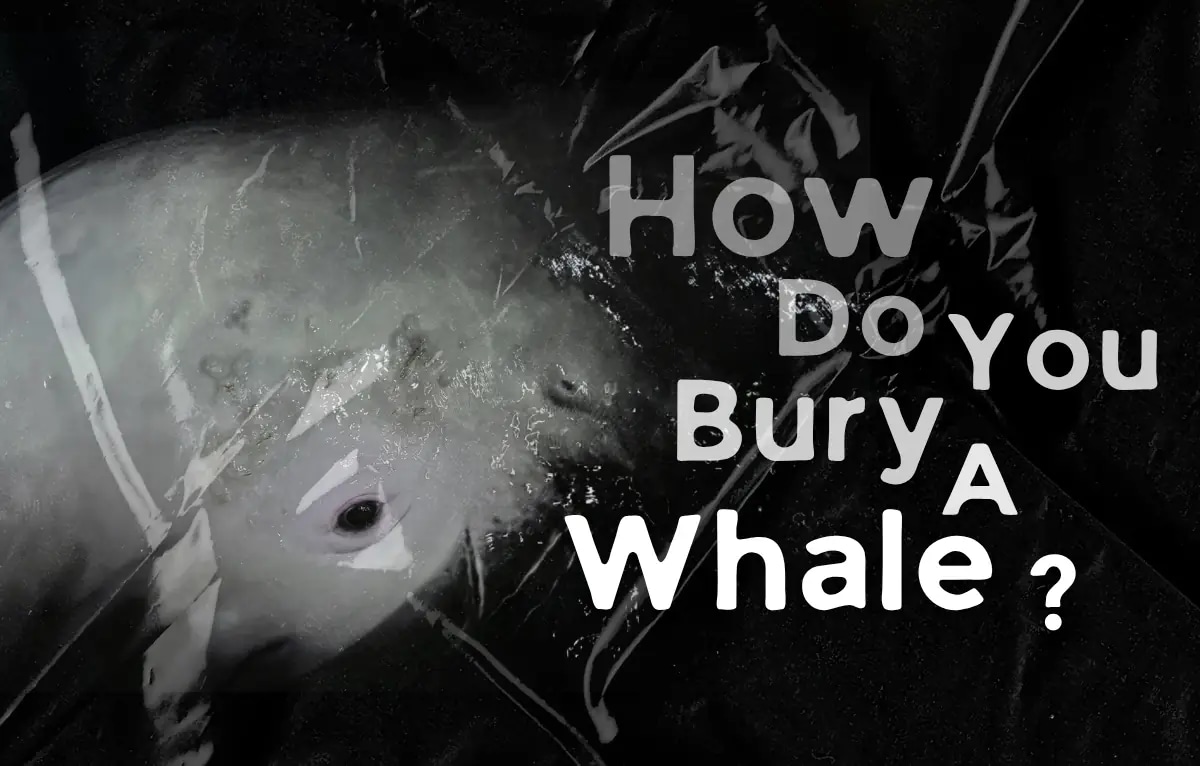
How Do You Bury A Whale? centres on the death of Dabai, a captive beluga whale. Rather than offering a dramatic reconstruction of his final moments, the production unfolds as a live investigation. Through testimony, sound, movement, video and fragments of archival material, the performers attempt to piece together the life of an animal who might otherwise have been quickly forgotten.
The production does not confine its attention to Dabai’s individual fate. Beginning with the death of one beluga, it gradually opens out to consider the treatment of other animals in marine parks: captured, transported and trained to perform the same routines within cramped, artificial environments. While alive, they can be watched, promoted and consumed. Once dead, they may disappear from public view with remarkable speed.

Image by Hetong Yang
By moving from one animal’s story towards the system surrounding it, the production makes clear that Dabai’s death was not simply an isolated tragedy. Its deeper concern is the relationship between spectatorship and captivity. When audiences sit in marine parks and applaud the movements of whales and dolphins, are they also helping to sustain the system that confines them? When humans say that they love these animals, does that mean caring for them as living beings, or enjoying their willingness to perform within the time and space we have prescribed?
At one point, the audience is invited to take out their phones and search for the site in Hangzhou where whales have been buried. It is a simple but effective interaction. As phone screens light up around the theatre, spectators cease to be passive recipients of information and temporarily join the investigation. The search connects the material presented onstage to a real geographical location. It also reveals that Dabai is not the only marine animal to have been buried — or otherwise dealt with — there.
In everyday life, an online search usually promises an immediate answer. Here, however, the phone produces not a complete truth but further questions. A point on a map appears to be no more than an ordinary set of coordinates. Only when the audience learns what lies beneath it does the place begin to acquire ethical weight. Contemporary society does not lack information; what it may lack are moments that make that information impossible to dismiss.
The interaction also reveals how the production understands the act of investigation. It does not belong exclusively to the artists onstage, but requires the audience to look, search and verify alongside them. Dabai’s death has not been forgotten because it left no trace. The traces may have been there all along; few people were willing to stop and ask where they led.
The performers are given relatively equal time onstage. No one emerges as the central protagonist in a conventional sense, and no performer remains fixed in the role of either Dabai or his keeper. Instead, they function collectively as investigators: arranging archival material, relaying testimony and raising questions.

Image by Zhuo Peng
This ensemble structure supports the production’s ethical position. Dabai is not a character for any one artist to possess, nor should his death become an opportunity for an individual performer to display emotion. By taking turns to speak, move and listen, the company largely avoids transforming an animal’s suffering into a personalised dramatic climax. The important question is not who will ‘play the whale’, but how human beings respond to the space left behind by his absence.
Towards the end, a conversation spanning Britain and China brings the previously scattered material back to a particular human relationship. The performers speak to one of Dabai’s keepers and ask how he feels about what happened. He does not attempt to offer a comforting explanation for the whale’s death. Instead, he describes a wish that can no longer be fulfilled: Dabai should have returned to his pod, or to the ocean where he once lived. Even if his whole body could not be returned, some part of him should at least have been allowed to go back to the sea.
His words are painful not only because they express regret, but because they acknowledge how little reparation humans can now offer. Dabai cannot regain his freedom or return alive to the ocean. All that remains for his keeper to imagine is a symbolic act of return after death.
How Do You Bury A Whale? has a distinct archival-theatre quality and a clear ethical purpose. Yet its present limitations also arise from its investigative form. The production raises many important questions without exploring each of them fully. What stages did the investigation go through? How do the testimony, the burial site and the records of other animals corroborate one another? How did the marine park respond? Was Dabai’s death an exceptional case, or a recurring consequence of a much larger industry? Some of these questions are addressed, while others remain at the level of suggestion.
The production’s investigative force would be stronger if it explained more clearly how its information was discovered and verified. The accumulation of archival fragments creates considerable weight, but the connections between them could be more precisely drawn. This does not mean that the performance must provide an answer to every question. Dabai is dead, and much of the truth may never be fully recovered. The power of documentary theatre, however, lies not only in expressing grief, but also in showing the audience how the artists reached their material: what has been confirmed, what remains impossible to prove, and which silences are themselves products of the system under examination.
How Do You Bury A Whale? is a production with a strong moral conscience. Its greatest value lies in its refusal to reduce the death of an animal to a fleeting tale of sadness. Dabai’s body was buried in a place that could easily be overlooked; through sound, testimony and collective acts of looking, the performance attempts to return him to public memory.
Perhaps the real question has never been simply how to bury a whale, but why humans wait until a life is over before acknowledging that it always belonged to the sea.