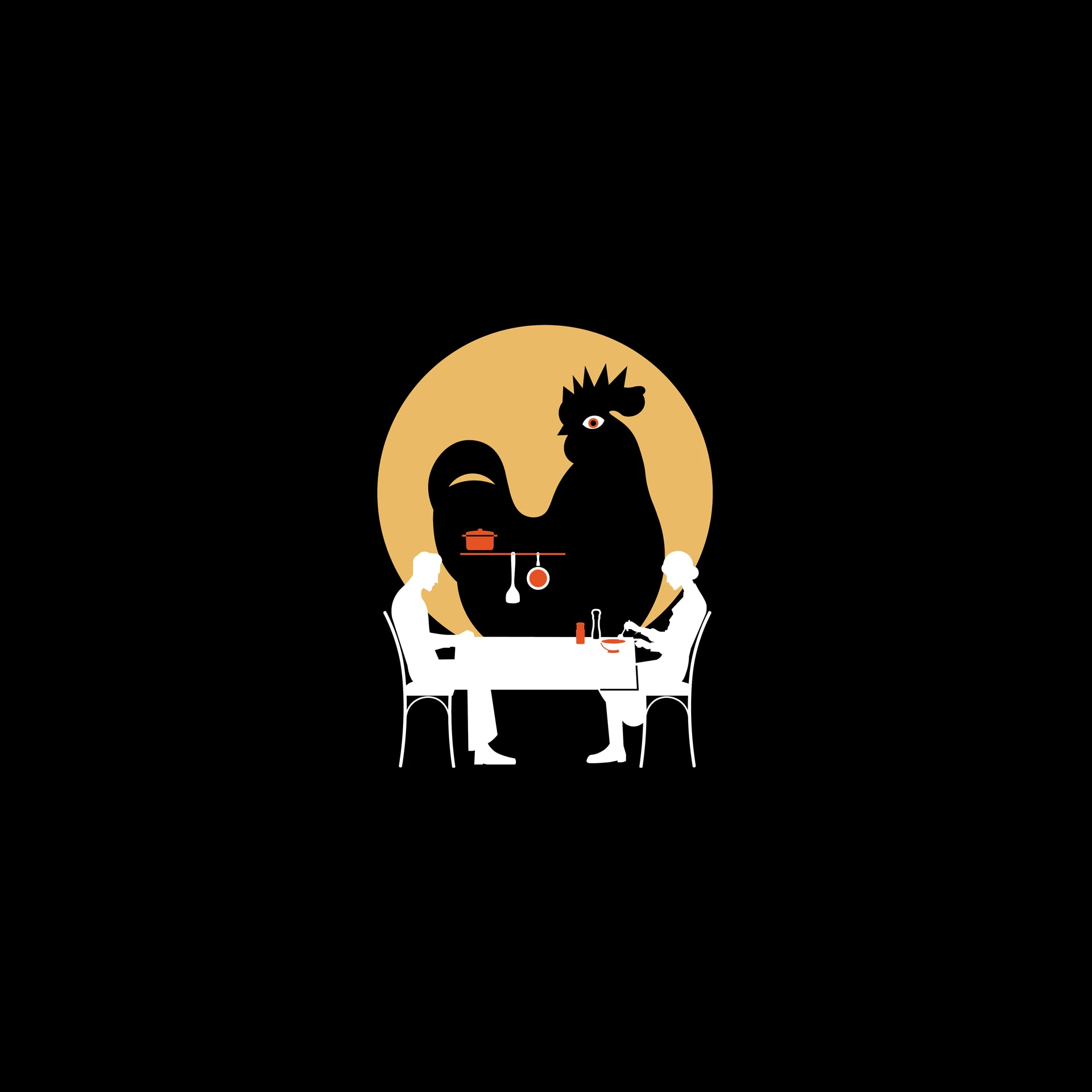
Image by Zhitian
Review by: Isabelle Wang
Rating: ★★★★

At first, the danger in Chicken Dropping seems to come from outside the window: the neighbours’ chickens fight day and night, their cries continually intruding upon the lives of Yifei and Ming. As the production unfolds, however, it becomes clear that it is not the chickens but this apparently peaceful and respectable household that is beginning to spiral out of control.
The play opens over breakfast. Ming is a husband who takes care of the home, preparing food for himself and his wife, Yifei. She is an ambitious banking professional who enters already caught up in the fast, efficient rhythm of her working day. She offers little response to the breakfast Ming has carefully prepared, quickly drinking the coffee she prefers instead. What concerns her more than the food on the table is the neighbours’ chickens: their relentless noise disrupts her sleep and, in turn, interferes with her work.
Ming, by contrast, believes that their life is already happy enough: an ocean view, breakfast, a stable marriage and the reassuring order of domestic routine. Within a single scene, the production gives us a clear initial outline of the couple’s contrasting personalities and values. Yifei is always looking outwards, placing great importance on her career and prospects of promotion; Ming wants to preserve the life they already have and is concerned with his position both at home and within the neighbourhood.
The following morning brings a small but significant change: Yifei’s coffee is missing, and the unspoken resentment between the couple begins to accumulate. Although she detests the neighbours’ chickens, her irritation rapidly turns to excitement when she realises that she can obtain their eggs for free. She eagerly explains her plan to Ming, as though the disorder outside their window has suddenly become an opportunity that can be calculated and exploited.
Ming is uninterested. He worries that Yifei’s scheme might damage his reputation among the neighbours. Their disagreement appears ready to deepen, but Yifei must leave for work, bringing the conflict to a temporary halt. Life seems to return to normal, but this appearance of calm is merely sustained by work and routine; the underlying problem has not disappeared.
As the chickens grow louder, Yifei can no longer tolerate the noise. Ming chooses the most direct solution: he steals and kills the neighbours’ chickens. He may expect Yifei to understand this as a sacrifice, perhaps even as proof that he acted ‘for her own good’, but her response is entirely different. She prepares a gift and insists that Ming apologise to the neighbours. Ming refuses, believing that an apology would damage his reputation.
Meanwhile, Yifei discovers footage of the theft in the neighbourhood WhatsApp group. Because the incident took place in the dark, the recording does not clearly identify the thief. This makes Ming even less willing to admit what he has done, and he goes so far as to demand that Yifei apologise in his place.
A fierce argument follows. The differences in values previously concealed beneath breakfast, work and domestic routine are now fully exposed. Ming is preoccupied with his reputation, while Yifei fears for her career and promotion. Neither wants to be the person who bears the consequences, and both repeatedly list everything they have contributed to the household.
At this point, care within the marriage becomes an account that must be settled. Every meal cooked, every hour worked and every sacrifice made is brought forward as grounds for demanding that the other person yield. On the surface, their argument is about who should apologise. In reality, they are deciding who must lose their reputation, career and future when the household enters a crisis.
Before this conflict can be explored fully, however, the play moves into the next day. Ming assumes that Yifei has dealt with the situation as he demanded, while she still refuses to accept responsibility for him. More seriously, Ming has not only told the neighbours that Yifei stole the chickens, but has also recorded clear footage of her burying them. The earlier video of Ming’s theft was obscured by darkness; the recording of Yifei is clear enough to leave her carrying all the consequences.
Yifei immediately realises that her professional life may be damaged. At this very moment, she is due to join a video meeting concerning her promotion. Ming prevents her from taking the call and instead forces her to sit down and eat.
The balance of power within the marriage suddenly shifts. Their conversation further reveals that Yifei’s ability to remain in the city is materially dependent upon Ming and their marriage. The woman who had previously rushed through her working day, always driving time forwards, abruptly loses her freedom to act or choose. All she can do is curl up in a corner and express her resistance through silence.
Ming places a bowl of soup in front of her and orders her to drink. When Yifei refuses again, he pours the soup onto the floor and commands her to drink it from there.
This is one of the production’s most powerful reversals. Food, initially a symbol of care and affection, has become an instrument of control and humiliation. Ming can still claim that he cooks and looks after the home; he can even insist that everything he does is ‘for Yifei’. Yet care has now been stripped of its tenderness, exposing the demand for power beneath it: because I have given something to you, you must live according to my will.
The domestic violence that follows destroys what remains of their relationship. While resisting Ming, Yifei accidentally kills him. She is immediately overwhelmed by shock and remorse, frantically apologising and seeking his forgiveness, but nothing can be undone. Ming dies.
Within fifty minutes, Dongmeng Chen establishes two sharply contrasting ways of living while ensuring that the characters’ actions remain, for the most part, psychologically comprehensible. The play’s appeal lies in its refusal to manufacture conflict through large-scale spectacle. Instead, danger grows out of the cracks in everyday life: coffee, breakfast, eggs, neighbourhood reputation and a single work meeting.
Food also provides the production with a clear line of action. Breakfast initially represents Ming’s care for the household; free eggs become an opportunity in Yifei’s eyes; the dead chickens bring consequences that cannot be passed on; and the final bowl of soup transforms care entirely into domination. As the meaning of food changes, the power structures previously hidden within the household are exposed one layer at a time.
Of the two characters, Yifei is the more fully realised. She is professionally ambitious and willing to seek advantage in the neighbours’ disorder; she is not entirely innocent. Yet when Ming crosses the boundaries of theft, killing and deliberate incrimination, she still tries to prevent the situation from worsening. Career, marriage, residency and moral responsibility all place pressure upon her, giving each of her decisions a tangible practical cost.
Ming’s transformation is not without foundation. He values stability and reputation, and believes that his contributions to the household have gone unrecognised. Nevertheless, his later progression from carer to controller and abuser feels somewhat too rapid. If the script developed his fear of losing his place within the home, his dignity and his control more fully, allowing signs of possessiveness to emerge more clearly beneath his early gentleness, the final violence would feel not merely like a plot reversal but the inevitable culmination of long-accumulated tensions.
The production is structurally fluent, with a witty and absurd sense of humour. However, some conflicts are interrupted by scene changes and the arrival of ‘the next day’ just as they appear ready to deepen. This keeps the fifty-minute play moving, but also deprives several crucial confrontations of some of their weight.
Director Zhaoyi Ying charts the changing relationship clearly and creates a strong contrast between the comedy of everyday domestic life and the danger of the later scenes. If the first two scenes were allowed to breathe a little more, leaving greater room for observation, hesitation and silence, the audience could feel the unease beneath the household’s apparent calm more fully. At present, the production sometimes seems to be continually hurrying towards its next plot point, when the couple’s unspoken emotions might reveal the problem earlier and more powerfully than open confrontation.
Clarissa Liaw and Tristen ZiJuin bring considerable humour and vitality to the production. They make the familiar complaints, miscommunications and stubbornness of a married couple feel truthful and entertaining, which makes the later reversal of their relationship all the more disturbing.
Liaw traces Yifei’s journey from the urgency and confidence of a career-driven woman to someone reduced to silent resistance in the corner of her own home. ZiJuin takes Ming from an enthusiastic domestic carer into self-justification and control. Even if the character’s transformation requires further support from the writing, both performances sustain the credibility of the conflict.
Chicken Dropping is not merely about a flock of noisy chickens, nor simply about the collapse of a marriage. Its real interest lies in showing how care can be itemised, how sacrifice can be used to demand repayment, and how acting ‘for the sake of the family’ can become an excuse for evading responsibility or controlling the person one claims to love.
Yifei and Ming initially believe that they are safe observers. They then discover profit in the eggs before becoming entangled in theft, killing and the displacement of responsibility. Only when feathers, bodies, droppings and violence enter their kitchen do they lose the distance that allowed them to remain bystanders.
Yet the concerns of Chicken Dropping do not end with the destruction of one marriage. The couple’s relationship provides a concrete space in which the play can explore a larger question. Through one kitchen, it transforms apparently distant violence into the sounds, food, profits and choices of everyday life.