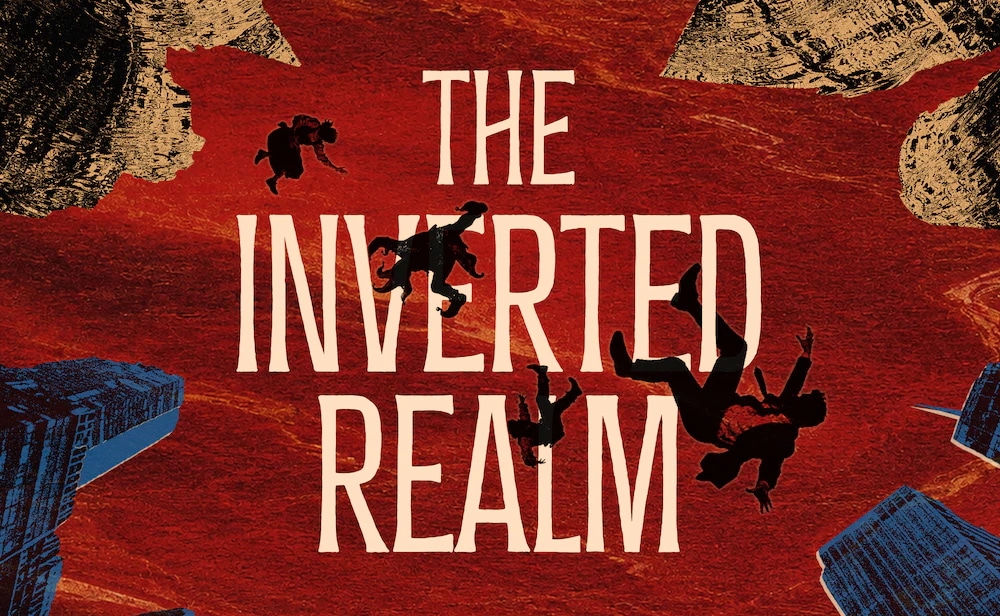
Image by The Inverted Realm Project
Review by: Blake Zhang
Rating: ★★★★
Inspired by Pieter Bruegel the Elder’s Netherlandish Proverbs, Inverted Realm brings a strange and surreal world to the stage, where the behaviour of its central character is turned upside down and reflected back at him. After its Edinburgh Fringe run in August, the production returned to London at Hoxton Hall as part of the London Burning Theatre Festival: As We All Lay Dying. Directed by Belle Bao, with Haiqing Liang as associate director and Leah Philbin as writer, the production uses physical performance and simple but effective stagecraft to create its unusual world.
The story follows the Traveller, played by Aleksandr Ganelin, a businessman who treats the people around him very differently depending on what he wants from them. He is polite and almost submissive when speaking to a business partner, but quickly switches to an aggressive and dismissive manner when dealing with his employee. After finishing a series of phone calls while driving, he suddenly finds himself in the Inverted Realm, a strange place where the rules of his own world are turned upside down.
The Fool, played by Dilip Kumar, seems to be in control of this new world. His performance is one of the highlights of the production. There is a bit of clowning and a bit of mime in his physicality, and he controls the other characters almost like a puppeteer, making them start and stop on his command. The cast also makes good use of repeated movements and precisely timed physical beats, giving the Inverted Realm a distinctive physical language.
The story becomes particularly interesting once the Traveller enters this world. What happens around him reflects the way he has treated other people, but with the roles reversed. He is no longer the person making the rules, and instead has to watch situations that seem completely absurd to him.
There are some wonderfully simple examples. One villager in the Inverted Realm owns an orchard, but refuses to give an apple to someone who is starving. The same villager finds a bone and throws it away because it seems useless, only to claim that it belongs to them as soon as another villager picks it up, before accusing them of stealing it. These moments are funny on the surface, but also point towards questions about capitalism, ownership and what we mean when we call something 'fair', especially when set against the Traveller's own greed and obsession with money.
Another scene revolves around trying to touch the moon, reflecting the Traveller's own unrealistic and blind ambition. The characters' seemingly impossible pursuit mirrors the unreasonable goals he sets for himself and the people working for him.
I particularly enjoyed the physicality of the production. Once the Traveller enters the Inverted Realm, the actors seem to move according to a completely different set of rules. This is especially effective in the final return to reality. After recognising the absurdity of what he has experienced, the Traveller takes the flame, represented by a candle and carrying a sense of hope, and passes through the frame back into the real world. The stage fills with deep blue light, accompanied by a voiceover, creating the feeling of waking up from a strange and slightly unsettling dream.
The production also makes a lot out of relatively little. With a limited budget, a decorated movable door frame is used to transform the space. Given the production's inspiration from Bruegel, it can also be read as a picture frame, creating a subtle link between the stage and the paintings that inspired it. Small props such as the blue apples and bone help build the visual world, while the costumes are also carefully considered. The characters have different looks as their identities shift, with most performers having at least two costumes to reflect these changes.
There are moments when the symbolism feels quite direct, but the combination of physical performance, surreal imagery and playful storytelling gives Inverted Realm a strong theatrical identity. By the end, the Traveller has been forced to see his own behaviour from the outside. Whether the experience will actually change him is left open, but his return to the real world after everything he has witnessed gives the ending a satisfying sense of possibility.