Image by Camilla Greenwell
Review by: Flynn Ng
Rating: ★★★★★
John Proctor is the Villain Review: A Masterclass in Reimagining Classic Texts through a Female Lens
After a year of anticipation, John Proctor is the Villain has finally made its way from Broadway to London, premiering at the Royal Court on March 20th. Following its seven Tony Award nominations last year, the London run is entirely sold out. So, does it live up to the hype? The thunderous, lingering applause and the tears shed at the finale offer a resounding “yes.”
Set in 2018 at a high school in a small Georgia town, the story follows a group of junior girls petitioning to start a feminist club. Against the backdrop of the burgeoning #MeToo movement, the town is gripped by a sense of unease. Their request is initially denied, with their counselor, Miss Gallagher (Molly McFadden), claiming she is powerless to help. However, Mr. Smith (Dónal Finn), their charismatic English teacher, extends a friendly hand. He suggests they frame it as a “lit club” tied to their study of The Crucible, allowing them to weave in feminist discourse, and volunteers to be their faculty advisor. The girls, who already look up to their learned and gentle teacher, are immediately won over.
Among them is Beth (Holly Howden Gilchrist), the class overachiever and Smith’s biggest admirer. She is brilliant and eager to learn, yet her conservative upbringing makes her painfully shy, her most common phrase being “I’m sorry.” Her best friend Ivy (Clare Hughes) is a “silver spoon” rich girl, innocent and kind-hearted, the daughter of a local elite. Their childhood friend Raelynn (Miya James) is a preacher’s daughter committed to purity, who recently ended a seven-year relationship with her boyfriend Lee (Charlie Borg) after he cheated on her with her best friend, Shelby (Sadie Soverall). Shelby has become a taboo subject among the group, but having been absent from school for months, the girls are secretly worried about her. Rounding out the group is Nell (Lauryn Ajufo), a newcomer as bright as Beth, who is slowly finding her footing in this new environment.
The plot kicks into gear during a feminist club meeting when Ivy fails to show up, but Shelby suddenly returns. From there, the tension escalates: Lee tries to force a reconciliation with Raelynn and is rejected; Smith brings a male student, Mayson, into the club for extra credit; Mayson, in turn, brings Lee to the meetings; and Ivy’s father is exposed for having an affair with his secretary. Finally, in class, Shelby challenges the “goodness” of John Proctor before breaking down and revealing her own affair with Mr. Smith. The play concludes with a hauntingly frantic dance, reminiscent of the girls in The Crucible who, deprived of entertainment, stripped of power, and trapped in stifling lives, danced in the moonlit woods to escape.
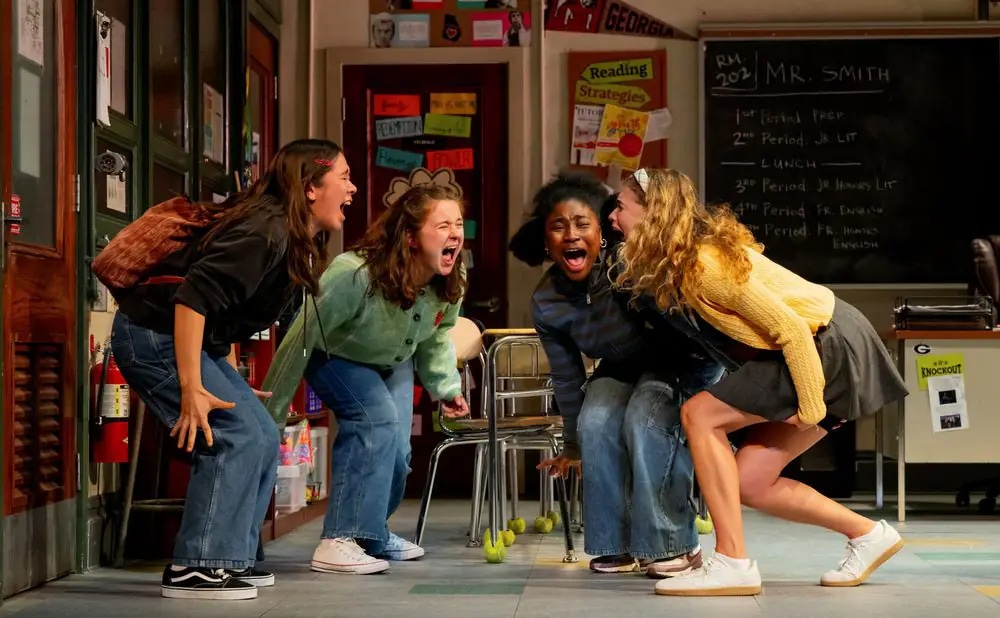
The most moving scene occurs when the girls, their lives in disarray and their understanding of feminism clashing with their harsh reality, begin to scream. One starts, then another, and another, until the room is filled with visceral, heartfelt howling. This is the essence of girlhood. What is adolescence made of? It is a litany of “sorrys” and “I don’t knows,” a long, piercing scream, and the fearless, uninhibited dance of reconciliation with a best friend. It is their only outlet.
The performances are stellar, particularly Sadie Soverall as Shelby. Initially appearing neurotic, pained, and self-destructive, she is not “likable” at first. However, as her vulnerability and self-reflection are laid bare, she becomes unforgettable. She is the first to declare that “John Proctor is the villain,” serving as a modern intertextual mirror to Abigail Williams. Like Abigail, she is an underage girl groomed by an older, admired man, yet her word is doubted. She spent months in isolation, healing in silence and enduring the pain of self-loathing that led her to betray her friend. Fortunately, the bond between these girls is real; the reconciliation between Raelynn and Shelby is beautifully realized through a shared cry in a classroom and a moment of laughter at a gas station.
Mr. Smith, Lee, and Mayson represent three archetypal male figures. Mr. Smith clearly parallels Proctor, a character he celebrates as one of the finest in American drama. His actions mirror John’s, though arguably in an even more despicable way. Lee, driven by entitlement, cheats and then harasses Raelynn, occasionally flashing a violent streak while believing his mere presence in the club is a grand effort. Mayson is the “converted” male feminist whose slips reveal the lingering biases of his upbringing.
Playwright Kimberly Belflower has a gift for capturing the specific cadence of high school speech, particularly within the conservative, religious atmosphere of the American South. The dialogue is full of hesitations and stumbles, yet the rhythm is incredibly fast-paced, which is a testament to director Danya Taymor’s skill. Across 16 scenes, the play masterfully handles information reveals and character arcs. The use of pop culture is equally sharp, especially the finale where Lorde’s “Green Light” accompanies an interpretive dance.
The play opens with the “perfect” Mr. Smith giving a sex education lesson. His first line, also the first line of the play, is “sex,” as he leads the students in reciting its definition. At the end, his final line, as well as the play’s last, is “alright, ladies,” as he tries to stop the girls’ cathartic dancing. It brings to mind the famous adage: everything in the world is about sex, except sex. Sex is about power.
John Proctor is the Villain is at the Royal Court until 25 April.
Photo from Royal Court Theatre.