Image by Charlie Flint
Review by: Isabelle Wang
Rating: ★★★★★
A small stage, a big world: The Gruffalo’s Child at artsdepot
Artsdepot, London, 3 April 2026.
There is a tendency in children’s theatre to overcompensate. Productions push too hard, underline too much, and confuse volume with energy. Tall Stories’ The Gruffalo’s Child does none of that. Seen at artsdepot, this adaptation was light on its feet, visually economical and, most importantly, confident enough to leave space for its audience. It understands a basic truth that many family shows miss: children do not need everything spelled out for them. Give them a strong rhythm, a clear world and something to imagine into, and they will do the rest.
That instinct serves this production well. The Gruffalo’s Child is not an obvious candidate for expansion. On the page, it is brisk, precise and built on the music of repetition. Stretching a picture book into a full stage piece can easily expose how little material there is, or flatten what made the original work in the first place. Tall Stories avoids both problems. Rather than padding the story with unnecessary business, it builds out its theatrical life through pace, play and invention. The evening feels properly shaped, not extended for the sake of it.
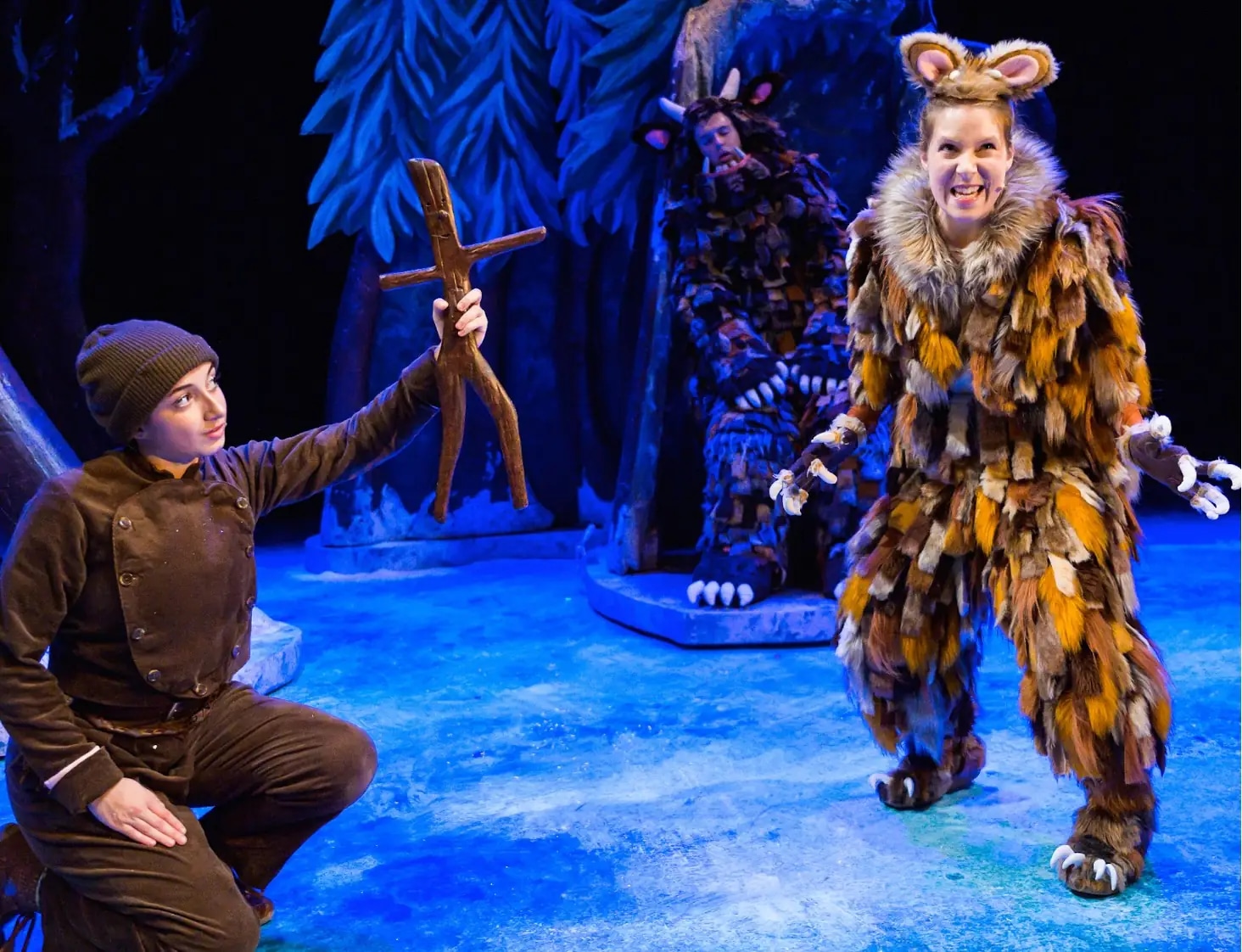
What stands out immediately is the design. The set is simple, but not thin; storybook-like, but not twee. A few trees, a handful of props, some neatly judged transformations, and suddenly the stage has depth and mystery. The production never tries to create a forest by brute force. It suggests one, and trusts the audience to meet it halfway. That choice proves wiser than any amount of decorative excess. Children are very good at imaginative completion. They do not need a fully built world when a half-glimpsed one will do.
The costumes are similarly well judged. Tall Stories resists the dead end of literal animal dress-up and goes instead for something more theatrical: recognisable silhouettes, playful textures, and just enough detail to spark the eye. Fox, Owl and Snake all arrive with strong identities, but none is trapped in realism. There is humour in the design, but also intelligence. The visual language stays close to the spirit of the book without becoming subservient to it. This is adaptation, not imitation.
That distinction matters throughout. The production’s greatest strength is that it does not treat the source as sacred object. It knows exactly what needs preserving and what can be reworked. What survives intact is the tonal balance: a child’s sense of adventure shadowed by a child’s sense of fear. This is, after all, a story about going out into the dark to look for something half-imagined and half-dreaded. The show catches that feeling well. It never pushes the danger so far that younger viewers withdraw, but neither does it sand away the thrill. The forest remains a place of uncertainty, which is precisely why the journey into it matters.

The performances are pitched with real care. There is plenty of energy, but no one is straining for effect. The acting has the open, generous quality good children’s theatre needs, while remaining grounded enough not to tip into relentless busyness. Just as importantly, the cast understands how to hold an audience of children without patronising them. The comic moments land cleanly, the storytelling is lucid, and the physical work has a playful ease that keeps the production moving.
The audience interaction is especially deft. Too often, children’s shows bolt participation on as a kind of duty, a brief pause in the story during which the auditorium is invited to shout at the stage. Here it feels more organic than that. The children are drawn into the action rather than pulled out of it. They are asked to watch closely, respond quickly and stay with the story. You could feel the room leaning forward. That kind of attention cannot be faked; it has to be earned.
What also lingers is the show’s refusal to turn its themes into a lesson. There is, clearly, something here about courage and about facing what seems frightening when seen from a distance. But the production is too sensible to package that into a moral and hand it over. Instead, it lets the idea emerge through action. The young Gruffalo goes looking for what frightens her, and in doing so discovers that the unknown is often stranger, smaller or more manageable than the stories told about it. The point arrives naturally, because it grows out of the adventure rather than stopping it.
Not every family show needs to be a major technical event, and The Gruffalo’s Child is stronger for knowing that. Its pleasures are not oversized; they are well made. It has charm, certainly, but also discipline. It knows how much is enough. In a theatrical culture that often mistakes “more” for “better”, that feels refreshing.
Tall Stories has made a show that is modest in scale and rich in effect. It never loses sight of its audience, but nor does it talk down to them. By the end, what remains is not just the pleasure of seeing a beloved book on stage, but the more satisfying sense of having watched a company use the theatre’s simplest tools well: bodies, objects, timing, suggestion. From those elements, it creates something large enough for children to enter and adults to admire.