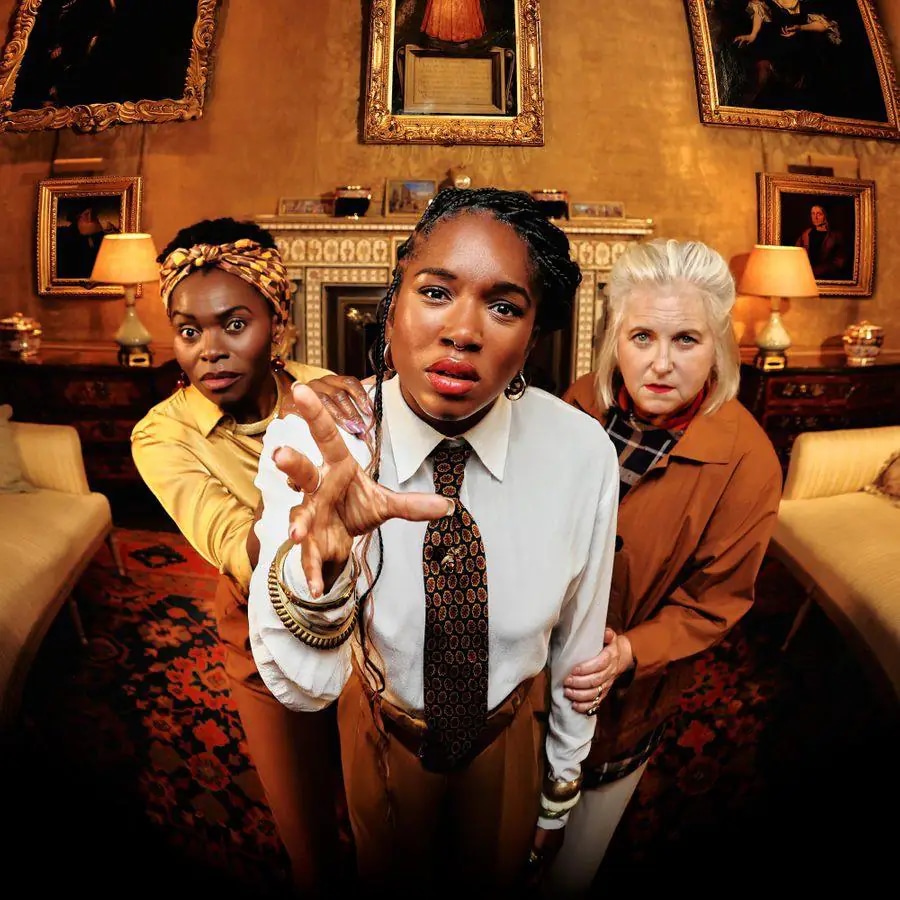
Image by Marc Brenner
Review by: Flynn Ng
Rating: ★★★
The Authenticator Review: Who Owns the Past?
Winsome Pinnock’s 90-minute new play asks difficult questions about inheritance, legacy, and the histories that families and institutions choose to erase. What happens when recovering those histories depends on methods that are themselves ethically unstable? And who gets to decide what counts as truth?
The story begins with Fen (Sylvestra Le Touzel), who has just inherited Harford Hall. While sorting through the estate, she discovers six journals left by her ancestors. These records come from a Jamaican plantation and document the workings of slavery in stark administrative detail. Enslaved people are listed alongside livestock. The archive is carefully kept, but what it contains is deeply unsettling.
Two historians arrive at the house. Abi (Rakie Ayola) and her mentee Marva (Cherrelle Skeete) each have complicated ties to the history of the estate. Abi once studied alongside Fen at Oxford, but Fen never acknowledged her. Marva’s grandfather has long insisted that he has a blood connection to the Harford family, a claim others have dismissed. After visiting the basement and encountering a blackmoor sculpture, whose name is just the same as her grandfather’s, Marva becomes more certain that her family story is real.
As the journals are examined, the historians uncover a record of punishment inflicted on an enslaved woman, Black Sarah. The language of the archive masks the violence, but what is described clearly includes sexual abuse and torture. The most important discovery comes when a torn-out page is reconstructed through pencil rubbing. Abi concludes that after the plantation owner’s wife gave birth to a stillborn child, a baby was taken from Black Sarah and raised as Henry Harford. The missing page contains Sarah’s testimony, written in grief and anger, claiming that one of her twins was taken and given to the plantation household.
The discovery changes everything for all three women. Fen takes a genetic test and learns she has 2 percent Black ancestry. She then rebrands herself publicly around this finding. Marva publishes a book that confirms her grandfather’s claims and secures her position as a legitimate descendant of the Harford lineage. Abi begins to question the material more closely and grows suspicious of what has been constructed as evidence.
When she tries to raise her concerns, Fen locks Abi and Marva in the basement, placing them with a sculpture of Black Sarah. Above them, Fen gives a public speech announcing a new foundation intended to address historical injustice. At the same time, Marva admits that she fabricated parts of the evidence. She describes it as both an emotional response and an attempt to reclaim a history that has been denied. She also turns the accusation back on Abi, suggesting that Abi’s background places her within a different structure of privilege, despite her long-standing work supporting students from disadvantaged backgrounds.
The play ends without resolution. Abi accepts the ambiguity of what has taken place. Fen gives her the letter from Marva’s grandfather, the one they had been searching for. The past remains incomplete, and the truth is left suspended.

Jon Bausor’s set design gives the production its strongest visual logic. The staging is restrained but effective, evoking the atmosphere of a Gothic country house. Mechanical lifts reshape the stage into shifting rooms, a basement, and a maze-like garden. The maze sequence is particularly striking. Fen stands at the centre telling the story of the Minotaur while Abi and Marva move through narrow pools of light, carefully shaped by Aideen Malone’s lighting design, searching for a way out. The garden evokes branching pathways and disorientation, recalling Borges’ The Garden of Forking Paths, where choice and uncertainty coexist within the same structure.
The staging makes the play’s central idea clear. History here is not linear or stable. It is a structure that disorients those inside it. Fen moves through it with ease, observing and narrating. Abi and Marva are placed inside it, forced to navigate its contradictions without certainty.
Even when truth is revealed, it does not affect everyone equally. For Fen, historical discovery becomes a form of reinvention and visibility. For Abi and Marva, the consequences are more immediate. Their academic standing, personal identity, and credibility are all placed under pressure. Fen’s awareness of ‘outsider’ experience does not fully escape her position within privilege. The play quietly points to the uneven distribution of historical pain and authority.
The tone shifts between thriller and dark comedy, though some coincidences in character relationships and revelations feel overly constructed. At times, the play moves closer to an idea-driven framework than a fully grounded narrative.
Overall, The Authenticator is most effective when it focuses on systems of knowledge and ownership rather than individual resolution. It leaves its questions open, even when its structure feels slightly overdetermined.
The Authenticator is at the Dorfman Theatre, National Theatre until 9 May.